
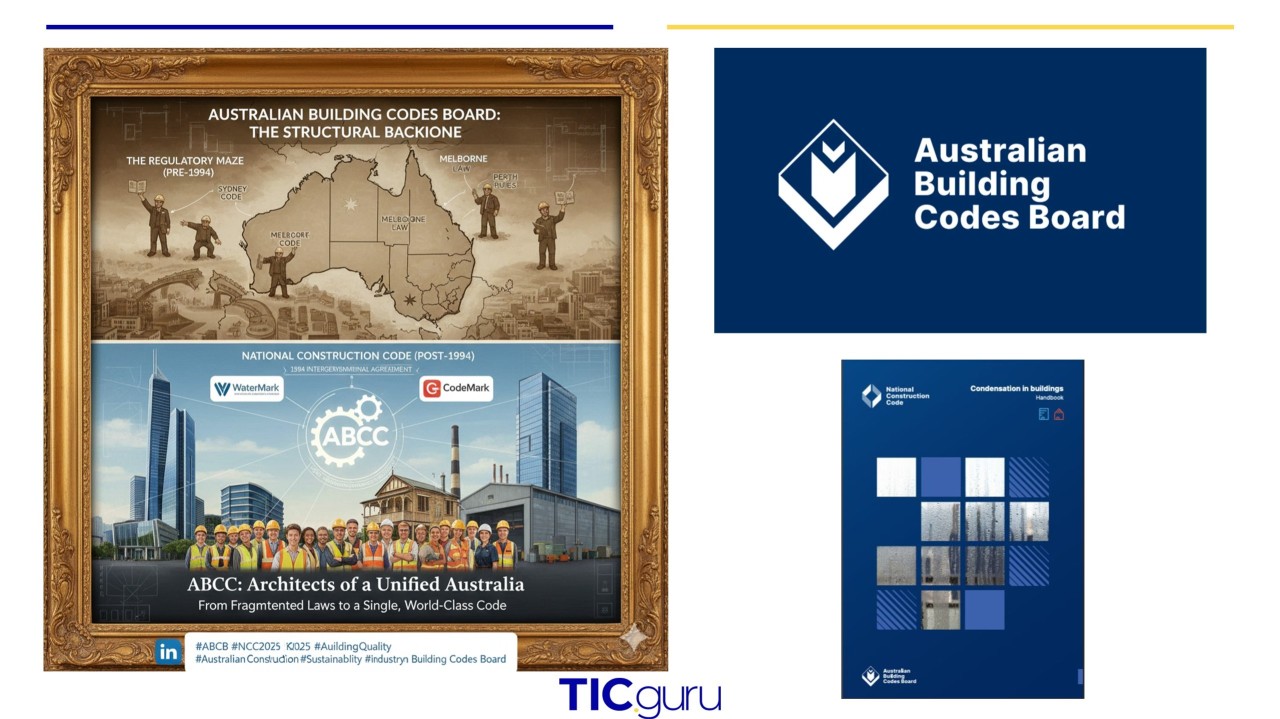
Born from the 1994 Intergovernmental Agreement (IGA), the ABCB was the answer to a crisis of inconsistency. Before 1994, building a house in Sydney and a commercial tower in Perth meant navigating two entirely different sets of laws. Today, the ABCB—now under the leadership of CEO Adrian Piani GAICD —ensures a single, technically robust national voice.
The NCC 2025 Evolution
With the preview released on February 1, 2026, the industry is bracing for a series of high-impact shifts designed to modernize our infrastructure:
- Commercial Solar Mandates: Mandatory on-site solar PV systems for commercial building classes to support Net Zero ambitions.
- Fire Safety Overhaul: Enhanced carpark fire safety provisions, particularly for commercial and apartment buildings.
- Condensation Management: Updated mitigation measures to address the health and structural risks of water ingress.
- The "Residential Pause": Building Ministers have confirmed a pause on new residential regulation changes (except essential safety/quality) until mid-2029 to provide industry stability.
The Technical Backbone: Referenced Standards
The NCC doesn't work in isolation; it "calls up" over 360 primary standards that provide the technical "how-to." When the ABCB references a standard, it effectively becomes Australian law. Some of them are
The Law: Who Enforces the Code?
A common misconception is that the ABCB is an enforcement agency. In reality, the ABCB is the "Author," but the States and Territories are the "Enforcers." The NCC is given legal force by specific state-based Acts:
- NSW: Environmental Planning and Assessment Act 1979
- VIC: Building Act 1993
- QLD: Building Act 1975
- WA: Building Act 2011
In the Australian building sector, the "teeth" of the law are found in State and Territory legislation, but the "brain" is the National Construction Code (NCC). To manage high-risk materials, these laws categorize products into different Conformity Assessment Levels based on their potential for failure.
The Gaps Between CASCO Standard Levels
In the building industry, not all "certificates" are equal. ISO/CASCO defines several "System Levels" (often called Schemes 1 through 6) for product certification. Understanding the gaps between these levels is critical for risk management.
Level 1: The "Snapshot" (Type 1a/1b)
- Process: One sample is tested in a lab. If it passes, a certificate is issued.
- The Gap: There is no ongoing surveillance.
- Risk: The factory could change their material source the next day, and the certificate would still "look" valid, but the product could be a failure.
Level 3: The "Factory Check"
- Process: Testing of a sample plus an initial audit of the factory's quality system.
- The Gap: Still lacks periodic "open market" testing.
- Risk: It ensures the factory can make a good product, but doesn't guarantee they always do.
Level 5: The "Gold Standard" (WaterMark & CodeMark)
- Process: Initial testing + Factory audit + Ongoing surveillance (yearly audits) + Market sampling.
- The Gap: This is the most robust level, but the gap here is Cost and Time.
- Impact: This level is mandated for high-risk products (like fire-rated cladding or plumbing that touches drinking water) to bridge the trust gap.
The "Evidence of Suitability" Hierarchy
The ABCB organizes these regimes into a hierarchy (NCC Part A5) to help builders navigate these gaps:
- Level A (Highest Trust): CodeMark or WaterMark (CASCO Level 5).
- Level B: Certificate of Conformity from a JAS-ANZ accredited body.
- Level C: A report from a NATA accredited testing laboratory (ISO/IEC 17025).
- Level D (Lowest Trust): "Expert Judgment" or other documentary evidence.
Why the Gaps Matter to the Industry
The gap between a Level 1 Test Report and a Level 5 CodeMark Certificate is often where building failures happen. A "Test Report" only proves that one specific piece of material was good on one specific Tuesday. A "Conformity Scheme" like CodeMark ensures that the entire production line remains consistent over years.
By mandating Level 5 for high-risk plumbing (WaterMark), the ABCB ensures that the "gap" in consumer safety is closed, preventing issues like lead contamination or mass plumbing failures in high-rise buildings.
The Key Conformity Assessment Regimes
These are the practical systems builders and plumbers use every day to show "Evidence of Suitability."
The following table correlates the enforcing lws with the required level of evidence and the specific high-risk materials they target.
The Future: Performance-Based Innovation
The future of the ABCB’s model is the shift from "Prescriptive" to "Performance-Based." By allowing Performance Solutions, the industry is empowered to innovate. If you can prove a new technology meets the safety goal of the NCC through scientific testing, you can build with it.
The Policy & Standard Bearers:
- Adrian Piani GAICD (CEO, Australian Building Codes Board ) – Driving the "Modernising the NCC" agenda.
- Standards Australia – Providing the technical standards that underwrite our safety.
The Guardians of Quality:
- Joint Accreditation System of Australia and New Zealand (JASANZ) & National Association of Testing Authorities, Australia (National Association of Testing Authorities, Australia) – Ensuring our labs and certifiers meet global benchmarks.
- Building Commission NSW & Victorian School Building Authority (VBA) – Enforcing excellence on the ground.
The Industry Titans:
- Denita Wawn (CEO, @Master Builders Australia) – Advocating for a sustainable and productive sector.
- Housing Industry Association (HIA) (HIA) – Supporting Australia's residential builders through regulatory shifts.
- Lendlease , Mirvac , & Multiplex x – Proving that performance-based design leads to world-class skylines.
#NCC2025 #BuildingQuality #ConstructionLaw #ABCB #StructuralSafety #WaterMark #CodeMark #Sustainability #NetZeroBuildings #ConstructionInnovation #Standardization