
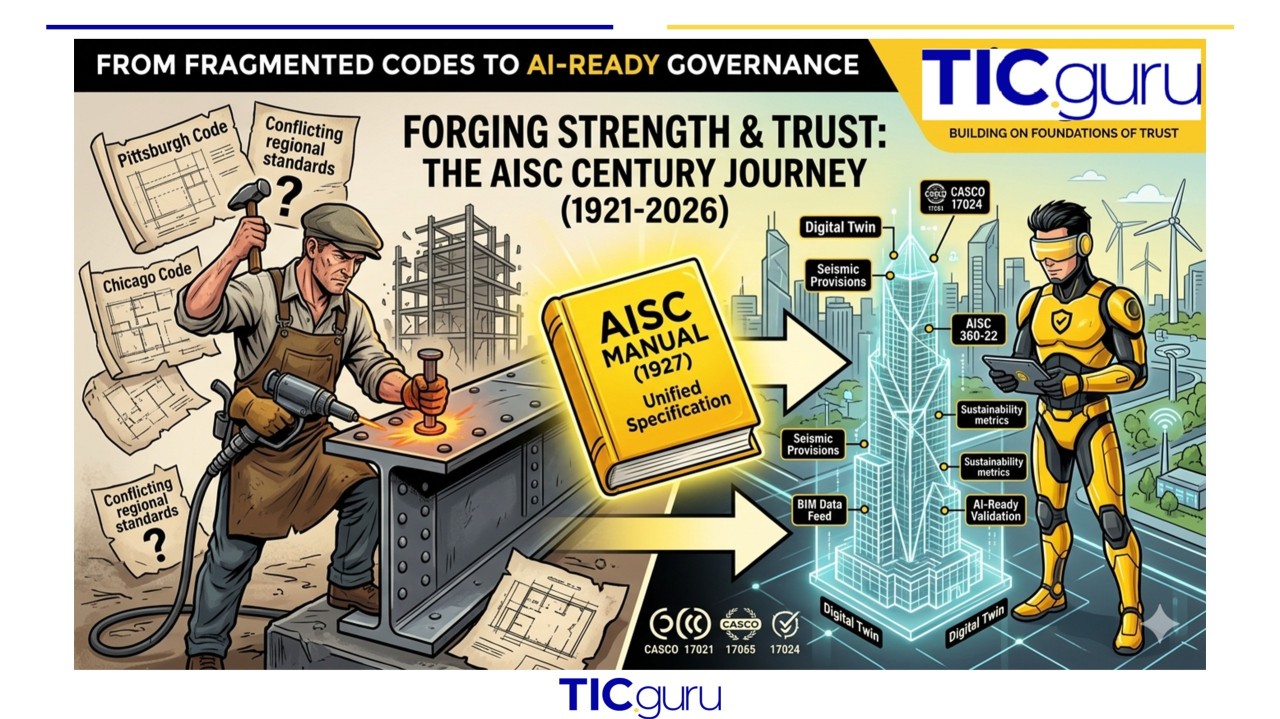
As we move into the second half of 2026, the AISC 360-22 Specification remains the ultimate 'source of truth' for structural integrity. Whether you are a fabricator in Pittsburgh or a developer in Dubai, the AISC seal is the difference between a 'structure' and a 'safe haven.' Let’s break down the 2026 publication landscape that defines our global skyline."
Lets take a deep dive today to American Institute of Steel Construction
The AISC Timeline: A Century of Strength
AISC’s history is a story of consolidation—turning fragmented regional practices into a single, unbreakable national standard.
- 1921 – Foundation: Established in Chicago to make structural steel the material of choice over concrete and wood. It was formed from the merger of the Bridge Builders Society and the Structural Steel Society.
- 1927 – The First Bible: The first edition of the Steel Construction Manual was published. This book has since become the most referenced volume in U.S. building codes.
- 1960 – The A-36 Revolution: AISC introduced A-36 steel, a stronger, more weldable material that allowed for the efficient skyscrapers we see today. AISC famously presented NYC with a symbolic $10,000,000 check to represent the savings this standard would bring to the city.
- 1990s – Unified Codes: AISC led the push to move away from three different regional building codes into a single national model, now known as the International Building Code (IBC).
- 2026 – The Future: AISC is currently rolling out the 2022 Specification (AISC 360-22) and Seismic Provisions (AISC 341-22), which for the first time include high-strength composite members and nonlinear response history analysis for earthquake safety.
Check out the AI cartoon
AISC Publication Summary (2026)
1. Core Technical Standards (The "Law")
These are the foundational documents adopted into the International Building Code (IBC) and are legally binding for structural safety.
- AISC 360: Specification for Structural Steel Buildings: The master document for US steel construction. The 2022 edition is currently the primary reference, with updates for fire conditions and high-strength composite members.
- AISC 341: Seismic Provisions for Structural Steel Buildings: Mandatory for high-seismic zones. It includes the new 2022 nonlinear response history analysis appendix. (Note: A draft for the 2027 edition is currently in public review).
- AISC 303: Code of Standard Practice (COSP): Governs the contractual relationship between the engineer of record, fabricator, and erector. A new draft was released in March 2026 to supersede the 2022 version.
- AISC 358: Prequalified Connections: Specifically for seismic moment frames, providing pre-approved connection details to save engineers from custom testing.
- AISC 370: Specification for Structural Stainless Steel Buildings: The first dedicated US standard for stainless steel, critical for highly corrosive or architectural projects.
2. Industry Manuals (The "Workhorses")
These are the physical volumes engineers keep on their desks to perform day-to-day calculations.
- Steel Construction Manual (16th Edition): Released recently, it combines the 2022 Specification with thousands of pages of design tables and properties for every standard steel shape.
- Seismic Design Manual (4th Edition): The companion to AISC 341, providing side-by-side LRFD and ASD design examples for earthquake resistance.
- Detailing Manual: Focuses on the "how-to" of preparing shop drawings, including standard bolting and welding symbols.
3. Design Guides (The Specialists)
As of early 2026, AISC has over 40 Design Guides that offer deep technical expertise on niche topics. See below
4. Digital Resources & Databases
AISC has moved aggressively into the Digital Twin space to support modern BIM (Building Information Modeling) workflows.
- AISC Shapes Database (v16.0): An Excel-based dataset containing all dimensions and properties for shapes (W, HSS, L, etc.) compatible with the 16th Edition Manual.
- Environmental Product Declarations (EPDs): Validated data used by designers to verify the embodied carbon of steel, which has reportedly dropped 10% industry-wide since 2021.
5. Certification Standards (Conformity)
These govern how businesses are audited and certified.
- AISC 207: Standard for Certification Programs: The Management System standard for fabricators and erectors. The 2025 edition is the current benchmark.
- AISC 420: Certification Standard for Complex Coatings: Specifically for shops that apply high-performance protective paints and finishes.
AISC Global Adoption Map (2026)
- United States: Primary jurisdiction. AISC 360 is the law of the land via the IBC.
- Middle East (GCC): Heavy use of AISC standards in the Energy and Petrochemical sectors. If you are building a refinery in Saudi Arabia, it is likely designed to AISC 360.
- Latin America: Often used as the "fallback" standard in nations without a mature local steel code for complex high-rise or mining projects.
AISC Global Adoption & Influence Map
Compliance vs. Guidance Ecosystem
The following table reconstructs the AISC publication classification, adding the specific ecosystem of companies that drive these programs and the industry leaders who utilize them. ATEMA Cives Steel Company STEELFAB, Inc , ADF Group inc. S. K. Ghosh Associates Intertek Degenkolb Engineers , Thornton Tomasetti , Skidmore, Owings & Merrill (SOM) Aws Welding (CWI Certification), Applied Technology Council The Herrick Corporation , Schuff Steel , BlueScope QMC , International Ironworkers (Training) PBI STEEL , Derr & Gruenewald Construction, LLC. AI Safety Connect (AISC) (Legal/Technical Advisory) Bechtel Corporation , Fluor Corporation , Kiewit Trimble Tekla , Bentley Systems (Software Integration) Arup WSP , Jacobs
New Proposed Conformity Programs
The following table introduces three proposed conformity programs that bridge the gap between AISC’s structural rigour and the 2026 demands for sustainability and digital precision.
The Future of Steel is Smart & Green
The era of just checking if steel is "strong enough" is over. As we navigate 2026, the American Institute of Steel Construction (AISC) framework is fusing with the cutting edge of global compliance. We are no longer just erecting beams; we are building data-verified, low-carbon structures.
The industry is rapidly shifting toward three new frontiers of trust:
- The Carbon Frontier: Transitioning from basic material checks to rigorous ISO/IEC 17065 product certifications for net-zero and recycled steel.
- The Digital Frontier: Using ISO/IEC 17029 to validate that the physical steel standing on-site perfectly matches its intelligent 3D Digital Twin.
- The Human Frontier: Moving past traditional inspection into highly specialized ISO/IEC 17024 personnel credentials for complex, non-linear seismic welding and engineering.
The physical skeleton of our cities is finally getting a digital and sustainable upgrade.