
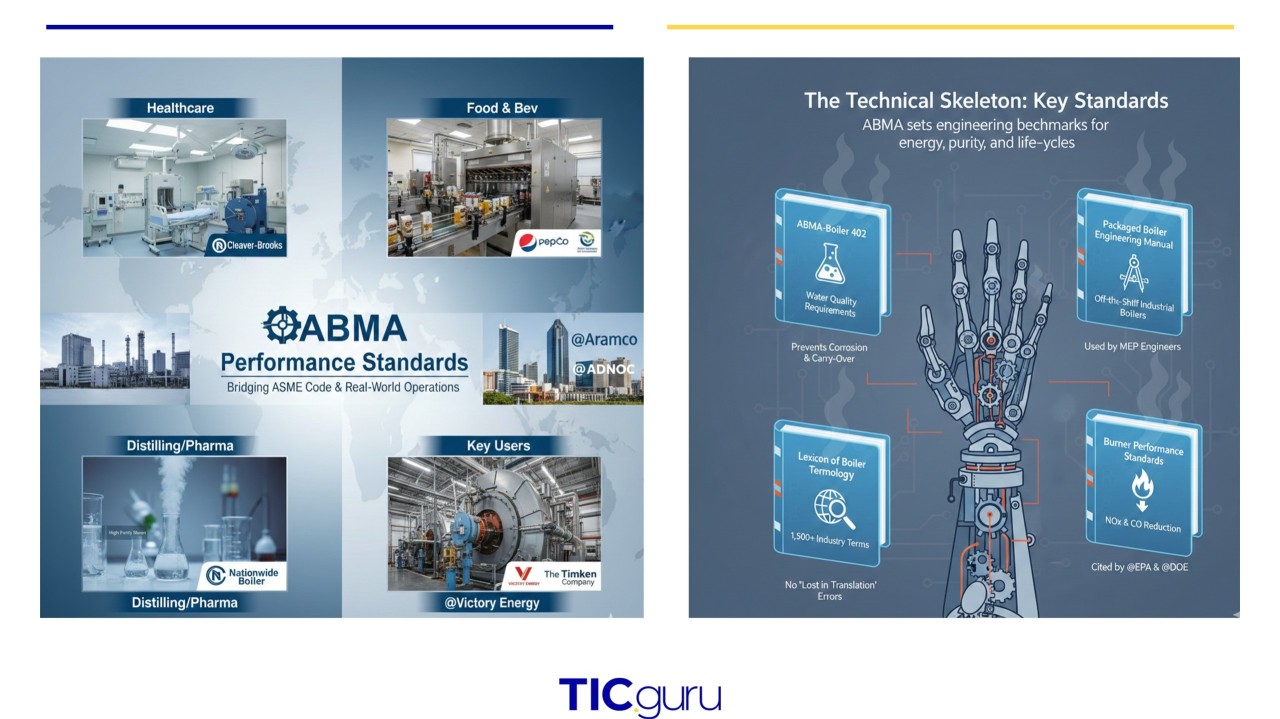
The American Boiler Manufacturers Association (ABMA) remains the technical heartbeat of the global steam and power industry. While often confused with its "bearing" cousin, this ABMA is the original guardian of industrial combustion, dating back nearly 140 years.
Here is the comprehensive guide to the SDO that keeps the world’s heat on and its pressure vessels safe.
The Guardian of Steam
Founded in 1888, the ABMA is the longest continuously operating trade association in the U.S. It serves as the primary advocate for the boiler supply chain, representing manufacturers of commercial, institutional, industrial, and electricity-generating boiler systems.
The Pittsburgh Pact
- The 1880s Chaos: Before 1888, boiler explosions were common—often called "Acts of God." In 1889 alone, a single industry journal reported 14 explosions killing 13 people in one month.
- The Pittsburgh Meeting (1888): Industry titans met at the Monongahela House in Pittsburgh to form a "united front" for safety.
- The Meier Legacy: Col. E.D. Meier, serving as President of both ABMA and ASME (The American Society of Mechanical Engineers) (1911), was the visionary who bridged the two organizations to create the first ASME Boiler & Pressure Vessel Code (BPVC) in 1914—the most significant safety document in engineering history.
Key Standards
ABMA doesn't just lobby; it sets the engineering benchmarks for how we calculate energy, purity, and life-cycles.
- ABMA-Boiler 402: The "Bible" of Water Quality Requirements. It dictates the chemical balance required to prevent catastrophic corrosion and "carry-over" in steam systems.
- Packaged Boiler Engineering Manual: The primary guide for "off-the-shelf" industrial boilers, used by every MEP engineer in North America.
- Lexicon of Boiler Terminology: The global standard for defining over 1,500 industry terms to ensure no "lost in translation" errors during high-pressure inspections.
- Burner Performance Standards: Crucial guides for $NO_x$ and $CO$ reduction, directly cited by the US Environmental Protection Agency (EPA) and U.S. Department of Energy
Extreme Pressure Trust
In the boiler industry, a "gap" in quality isn't just a defect; it's a potential bomb. The ABMA enforces a strict conformity regime through the National Board of Boiler and Pressure Vessel Inspectors (NBBI), aligned with CASCO principles.
- The "S" and "R" Stamps (ISO/IEC 17065): Through the ASME/NBBI framework, manufacturers must be certified to apply an "S" Stamp (New Construction) or "R" Stamp (Repair). This is a Level 5 conformity assessment involving third-party audits.
- Lab Testing (ISO/IEC 17025): Burner efficiency and emission levels are verified in accredited labs to ensure they meet EPA and state-level "Clean Air" mandates.
- Surveillance: Authorized Inspectors (AIs) must be present during the manufacturing process—a level of oversight rarely seen in other industries.
Because these services are often required by law (State Labor Acts or OSHA), the Authorized Inspection Agency (AIA) market is highly specialized.
The Big Three Global AIAs:
- HSB - Hartford Steam Boiler : Owned by Munich Re , they are the worlds largest AIA. They effectively wrote the book on boiler insurance and inspection.
- TÜV SÜD / TÜV Rheinland Group The German giants who bridge the gap between American (ASME) and European (PED) compliance.
- Bureau Veritas / SGS : Provide global Global Passport services, helping manufacturers in Asia export ABMA-standard boilers to the USA.
The Regulators/Registrars:
- The National Board of Boiler and Pressure Vessel Inspectors (NBBI): The Police of the industry. They dont just set standards; they maintain the central registry of every legal boiler in North America.
- ASME (The American Society of Mechanical Engineers) The issuer of the Certificates of Authorization (the legal right to use the Stamp).
Opportunities for New Programs
- Hydrogen Verification: There is currently no unified ISO/IEC 17065 scheme specifically for "Hydrogen-Ready" boilers.
- Cyber-Physical Safety: As boilers connect via IoT (Boiler 4.0), we need a bridge between mechanical inspection (17020) and cybersecurity (IEC 62443).
Top Countries and Regions of Adoption
The American framework is the most widely recognized technical "passport" in the world, facilitating trade across borders where safety is paramount.
aramco , ADNOC Group , and QatarEnergy
The Philosophy Gap: American vs. European
Understanding the difference between these standards is crucial for global manufacturers:
- The American Way (ABMA/ASME): An Ecosystem of Codes. You use ASTM for materials, ABMA for burner specs, and ASME for the vessel design. It relies on a prescriptive approach—follow the rules, and you are safe.
- The European Way (EN/PED): A Safety Goal approach. The law tells you what the safety outcome must be (e.g., the vessel must not burst), and the manufacturer is responsible for proving they met that goal through risk assessment.
Risk Note: A common gap occurs in material certification. A steel plate certified as ASTM A516 Gr. 70 (American) is not automatically accepted as P355GH (European) without additional impact testing and notified body verification.
The "New Service" Frontiers for 2026
The industry is currently facing a "Technical Debt" where traditional standards don't cover 2026 technologies. This creates a massive opportunity for new compliance services:
A. Hydrogen-Ready Verification
As companies like Cleaver-Brooks and Babcock & Wilcox x move to hydrogen blending, we need new ISO/IEC 17065 schemes to certify "Hydrogen Compatibility."
- Service Gap: Verification of burner flame stability and material embrittlement for 100% Hydrogen firing.
B. Boiler 4.0 & Cybersecurity (IEC 62443)
Modern boilers are IoT-connected. A hacked boiler isn't just a data risk; it's a physical weapon.
- Service Gap: Integrating ISO/IEC 27001 (Information Security) with ISO/IEC 17020 (Mechanical Inspection) to provide "Cyber-Physical Safety Audits."
C. Remote Inspection (AR/VR)
Post-pandemic, the industry is struggling with a shortage of qualified inspectors.
- Service Gap: Accreditation programs for "Digital Twin" Inspections, where an inspector at HSB - Hartford Steam Boiler uses high-def drones or AR glasses to perform a 17020-compliant inspection from 2,000 miles away.
Key People:
- Scott Lynch (President & CEO, ABMA)
- Nancy Simoneau (Chair, Le Groupe Simoneau )
- Bryan O'Toole (Vice-Chair, Burnham Holdings, Inc. )
- Mark Wehmeier (Secretary/Treasurer, Webster Combustion n)
- John Viskup (Board Member, Victory Energy Operations, LLC )
Key Companies:
- Cleaver-Brooks
- RENTECH Boiler Systems, Inc.
- Superior Boiler
- Victory Energy Operations, LLC
- Nationwide Boiler Inc.
- HSB - Hartford Steam Boiler
- MIURA AMERICA CO., LTD.
#BoilerSafety #EngineeringHistory #ABMA #ASME #HydrogenFuture #SteamPower #IndustrialInnovation #CleanEnergy #Sustainability #Manufacturing