The American Chemistry Council (ACC) stands as the premier architect of the "Molecular Transition." While it is widely known as a powerful advocacy group, its role as a Standards Development Organization (SDO) is what provides the world with the "license to operate" in the high-stakes world of chemical manufacturing.
Here is the definitive guide to the ACC, the Responsible Care® movement, and why this organization is the backbone of the $600 billion U.S. chemical industry.
History Snippets: From Defense to Responsibility
Founded in 1872, the ACC represents the companies that create the building blocks of modern life—from life-saving medical devices to the high-purity gases required for the next generation of semiconductors. It is a technical powerhouse that turns complex chemistry into manageable, safe, and sustainable industrial frameworks.
- The 1872 Origins: Born as the Manufacturing Chemists Association (MCA), its original mission was to protect the nascent U.S. chemical sector from European industrial dominance.
- The 1988 Pivot: Following global industrial tragedies in the 1980s, the ACC (then the CMA) made a historic decision. They adopted Responsible Care® from Canada, making it a mandatory condition of membership. This was the first time an industry voluntarily chose to regulate its own safety performance through third-party audits.
- The 2000 Rebrand: The name changed to the American Chemistry Council to reflect that "chemistry" is more than manufacturing—it is a science-driven solution for global challenges.
The Technical Blueprint: Key Standards
The ACC does not just issue guidelines; it issues Management System Technical Specifications that are legally and commercially binding for its members.
- RC14001®: The industry's "Gold Standard." It merges the environmental rigor of ISO 14001 with the specific safety and security mandates of Responsible Care.
- RCMS® (Responsible Care Management System): A specialized technical specification for companies requiring a chemical-focused safety structure without full ISO 14001 integration.
- The Three Pillars (Codes of Practice):
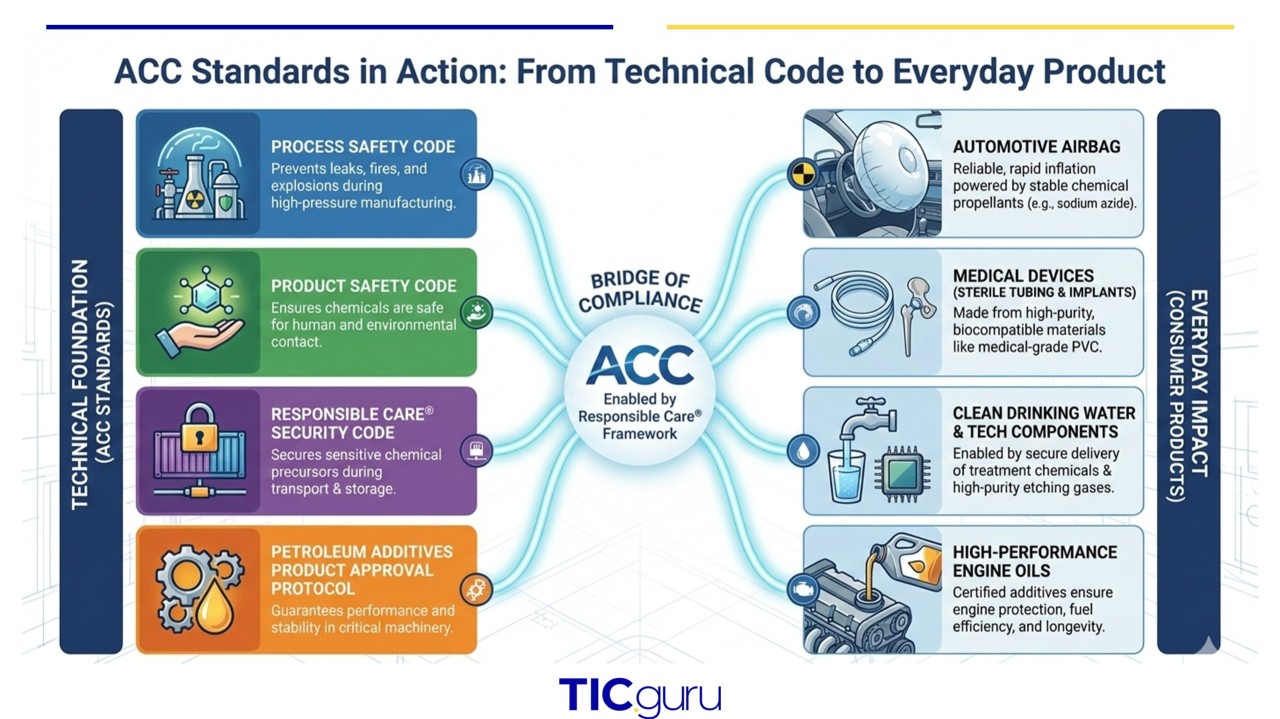
- Product Safety Code: Standardizes risk communication across the global value chain.
- Process Safety Code: The engineering blueprint for preventing leaks and explosions in complex plants.
- Security Code: Hardened standards for physical and cybersecurity, developed in tandem with the Department of Homeland Security, Office of Inspector General (DHS).
Global Footprint & Key Businesses
While headquartered in the USA, the ACC’s framework is the global language of chemical safety through the ICCA - INTERNATIONAL COUNCIL OF CHEMICAL ASSOCIATIONS (ICCA).
- Primary Regions: Dominant in North America, with heavy adoption in the Middle East and Southeast Asia as global titans export these standards to their international subsidiaries.
- Key Industry Segments: Petrochemicals, Specialty Chemicals, Plastics, Logistics (Rail/Truck), and Industrial Gases.
- The "Responsible Care" Titans:
- Dow , BASF North America, and ExxonMobil Chemical : The leaders in large-scale standard implementation.
- The Chemours Company : Driving the "Force for Good" and modern sustainability benchmarks.
- Union Pacific Railroad : A critical Responsible Care Partner that ensures the "Safety Train" never stops.
Building the Chain of Trust
The ACC’s conformity programs are anchored in the ISO/CASCO Toolbox, ensuring that "Trust but Verify" is backed by international accreditation. The table captures some examples
DNV (Det Norske Veritas) ABS Quality Evaluations (ABS QE) NSF International Strategic Registrations (NSF-ISR) DQS Amtivo® (USA) (formerly QSR/Orion) Intertek SAI Global Verrico Associates DEKRA Certification
The 2026 chemical landscape is no longer just about preventing leaks; it’s about proving sustainability, securing digital brains, and managing the "Green Molecular Transition." For conformity bodies, the "Responsible Care" framework is the perfect foundation, but the "next-gen" opportunities lie in bridging the gap between traditional chemistry and the digital/circular future.
Here are five high-value conformity programs that are Possible future opportunities based on American Chemistry Council (ACC) ecosystem, mapped to the ISO/CASCO Toolbox.
The Future: Chemistry in the Age of AI & Net Zero
By 2026, the ACC has shifted its focus to the "Great Energy Transition" and the digitalization of the plant floor.
- The Hydrogen Economy: Drafting the safety protocols for massive hydrogen hubs.
- Circular Economy: Standardizing the molecular tracking of plastics to eliminate waste.
- AI-Enhanced Safety: Integrating ISO/IEC 42001 (AI Management) with process safety to ensure autonomous plants remain fail-safe.
Key Leadership: Chris Jahn (President & CEO, ACC) | Mitchell Toomey (VP, Sustainability) | Steve Prusak (CEO, Chevron Phillips Chemical Company ) | Mark Vergnano (FOSSI Initiative)
Industry Titans & Partners: American Chemistry Council | Dow | BASF | The Chemours Company | ExxonMobil | Union Pacific Railroad | Kenan Advantage Group (KAG) | LyondellBasell | Eastman | AdvanSix | Olin
Accreditation & Audit Bodies: ANAB - ANSI National Accreditation Board | DNV | Abs Quality Evaluations Inc | NSF International | Intertek | DEKRA
#ResponsibleCare #ChemistryCreates #SafetyStandards #ACC #RC14001 #Sustainability #HydrogenEconomy #CircularEconomy #Manufacturing #EngineeringLeadership #ISO17021 #CASCO #NetZero2026 #ProcessSafety