
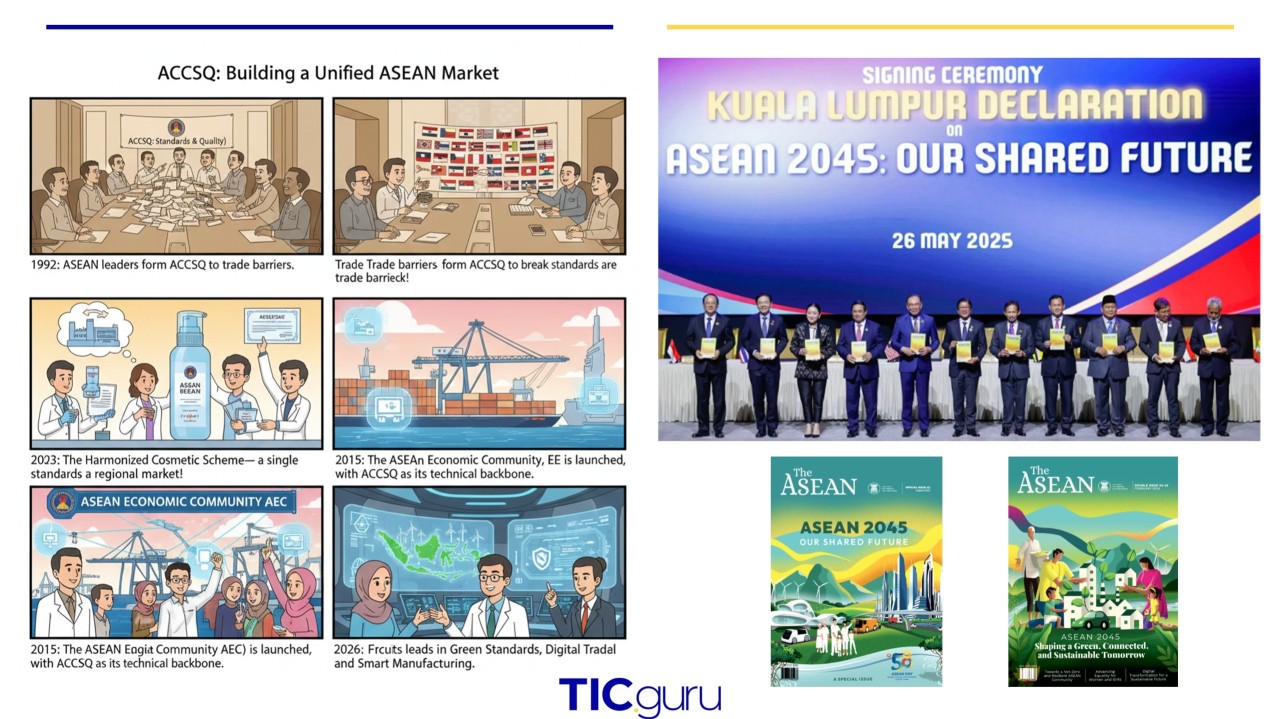
The ASEAN Consultative Committee on Standards and Quality (ACCSQ) is the technical engine driving the "Single Market" vision for 10 Southeast Asian nations. While individual countries maintain sovereignty, the ACCSQ ensures that a medical device made in Singapore can be sold in Vietnam without redundant testing—a feat of regulatory harmonization that powers the region's massive growth.
The ACCSQ operates as a "Hybrid SDO." Rather than drafting every sentence of a standard from scratch, they act as a Regional Standards Harmonization Body. Their goal is to take international excellence (like ISO or IEC) and "ASEAN-ize" it to ensure it works across all 10 member states.
The Focal Point of ASEAN Integration
Established in 1992, the ACCSQ was born from the ASEAN Free Trade Area (AFTA) initiative. Its primary mission is to eliminate Technical Barriers to Trade (TBT). It reports directly to the ASEAN Economic Ministers (AEM) and is the guardian of the region's "Quality Infrastructure."
Milestones in Harmonization
- The 1992 Mandate: As ASEAN moved toward a free trade area, leaders realized that tariffs weren't the only barriers—conflicting standards were. The ACCSQ was formed specifically to address Standards, Technical Regulations, and Conformity Assessment Procedures (STRACAP).
- The 20priority Products (1990s): In its early years, the ACCSQ began by harmonizing national standards for 20 priority products (including safety and EMC standards) identified under the AFTA trade objectives.
- The 2003 Cosmetic Breakthrough: The signing of the ASEAN Harmonized Cosmetic Regulatory Scheme was a watershed moment. It replaced 10 different national rules with a single ASEAN Cosmetic Directive (ACD), allowing the region to compete with global beauty giants.
- The 2015 AEC Launch: The official launch of the ASEAN Economic Community (AEC) in December 2015 catapulted the ACCSQ into its modern role, tasked with creating a single market and production base through the free flow of goods.
"Harmonization over Reinvention"
The ACCSQ’s primary goal is not to create a unique "ASEAN-only" standard that isolates the region, but to align the 10 member states with International Standards (like ISO, IEC, and Codex Alimentarius).
- Identical Adoption: They select an international standard (e.g., ISO 13485 for medical devices) and mandate that all 10 countries adopt it as their national standard.
- Modified Adoption: If the region has specific climate or infrastructure needs (like high-humidity requirements for electronics), they may "modify" an international standard to create an ASEAN-specific version.
The SDO Factory: Working Groups (WGs)
The actual "development" work happens within specialized groups. If the ACCSQ were a factory, these would be the production lines:
The SDO's Output: "Regulatory Regimes"
Unlike a traditional SDO which produces voluntary standards, the ACCSQ often produces Harmonized Regulatory Regimes. When they develop a standard, it often becomes mandatory for trade within the region.
- ASEAN Common Technical Dossier (ACTD): A standardized "technical recipe" for pharmaceutical data.
- ASEAN Cosmetic Directive (ACD): A regional law governing ingredients and labeling.
While they align primarily with international giants like ISO, IEC, and UNECE, their success in harmonizing these across 10 diverse nations varies based on the technical complexity and regulatory maturity of each sector.
Success Drivers vs. Barriers
The ACCSQ's performance is often a tug-of-war between regional ambition and technical reality:
- High Success Drivers: Sectors where global standards already exist (IEC/ISO) and where the economic incentive for a "single market" is undeniable (e.g., Electronics and Pharma).
- Low Success Barriers: "Sovereignty-heavy" sectors where national safety or health laws are deeply entrenched (Foodstuff, Construction) or where the testing infrastructure in some member states is still maturing
The Regional Gatekeepers (National Accreditation Bodies)
These bodies are the highest technical authorities in their respective countries. They are responsible for auditing and accrediting the CABs to international standards like ISO/IEC 17025 or ISO/IEC 17065.
Major Industry Conformity Assessment Bodies (CABs)
These are the private and state-owned powerhouses that carry out the actual testing and certification. To work across the ASEAN region, they must be "Designated" by their national governments and listed on the ASEAN Main Portal.
Global Certification Giants (The Multi-National Players)
These firms have a massive footprint across all 10 ASEAN nations and are often the first choice for multi-national manufacturers.
- Intertek : A leading Designated Body for the ASEAN EE MRA. Intertek Singapore, for example, is designated to certify electrical products for Cambodia, Indonesia, Malaysia, and Vietnam.
- TÜV SÜD : Deeply integrated into the Thai (TISI) and Singaporean markets; specialized in medical device and electronics compliance.
- SGS : Heavily involved in Indonesia (SNI certification) and Vietnam (QUATEST support) for food safety and consumer products.
- UL Solutions : Provides critical testing for the ASEAN Power Grid initiatives and EV battery safety.
B. National Technical Powerhouses (The Local Giants)
These organizations are often government-linked and serve as the "National Reference" for standards.
- SIRIM QAS International (Malaysia): The primary certifier for the Malaysian market and a key partner for the Automotive and Construction PWGs.
- PT. SUCOFINDO (Indonesia): A massive state-owned enterprise supporting Indonesia’s dominance in the Rubber and Agro-based sectors.
- QUATEST 3 (Vietnam): The "Quality Assurance and Testing Centers" (1, 2, and 3) are the primary entry points for any electrical or industrial goods entering the Vietnamese market.
Strategic "Dialogue Partners" (Global Technical Support)
The ACCSQ does not work in isolation. In 2026, several international bodies provide the funding, training, and technical expertise to help SE Asian CABs meet global levels.
- National Institute of Standards and Technology (NIST) (USA): Provides technical exchange programs for metrology and cybersecurity.
- Physikalisch-Technische Bundesanstalt, PTB (Germany): A long-term partner in the "Quality Infrastructure for ASEAN" project, helping labs in Cambodia, Lao PDR, and Myanmar reach ISO/IEC 17025 accreditation.
- Global Accreditation Cooperation Incorporated (Global ACI) (GAC): Launched in January 2026 (replacing ILAC/IAF), this new global body ensures that a test report from a Designated Body in Thailand is trusted in Europe or America.
Institutional Leaders
- The ASEAN Secretariat
- Department of Standards Malaysia (JSM)
- Enterprise Singapore
- BSN ( Badan Standardisasi Nasional ) - Indonesia
- Thai Industrial Standards Institute [TISI]
Key Voices:
- Dr. Kao Kim Hourn (Secretary-General of ASEAN)
- Satvinder Singh (Deputy Secretary-General for AEC)
- ERIA: Economic Research Institute for ASEAN and East Asia
#ASEAN #ACCSQ #TradeFacilitation #Standardization #EconomicIntegration #AEC2025 #QualityInfrastructure #MedicalDevices #PharmaRegulatory #SEAsiaBusiness #ISO17025 #MRA #SupplyChainSEAsia