While AIA handles the physical "nuts and bolts," the American Institute of Aeronautics and Astronautics (AIAA) is the architect of the mathematical and scientific logic that makes flight possible.
Founded in 1963 through the merger of two historic societies, it has evolved into the world's largest aerospace technical professional society. In 2026, AIAA is the primary "Think Tank" defining the rules for the Cislunar Economy (the region between Earth and the Moon) and Autonomous Air Mobility.
The First "Space Traffic" Manual : Lets look into History
While it officially formed in 1963, its roots go back to a time when talking about space travel could get you laughed out of an engineering office. AIAA’s oldest ancestor, the American Interplanetary Society (AIS), was not founded in a lab, but in a New York City apartment belonging to a Herald Tribune reporter.
- The "Literary" Founders: Most of the 12 original founders were actually science fiction writers and journalists, not engineers. They were dreamers who wanted to make the stories they wrote come true.
- The "Speakeasy" Spark: An excellent speakeasy operated in the basement of the building, which reportedly helped "keep the spirit of the discussions high" during their early meetings.
- The Name Change: In 1934, they changed their name to the American Rocket Society (ARS) because "Interplanetary" sounded too much like science fiction for the serious scientists they were trying to recruit.
Lets check out our cartoon strip to continue the story
Here is some more fun
AIAA Publications
In 2026, the AIAA maintains a library of approximately 150+ active standards, guides, and recommended practices. While they don't produce the sheer volume of "part standards" that the AIA does, their publications are the mathematical and logical "Source of Truth" for the global aerospace industry.
Here is more
Compliance Matrix for 2026
These documents are increasingly integrated into ISO/IEC (CASCO) compliance regimes, particularly those involving Validation and Verification (ISO/IEC 17029) and Testing Competence (ISO/IEC 17025). Lets look at some use cases
Global Compliance Participation
AIAA publications are rarely "voluntary" for top-tier aerospace companies; they are typically written into the Statement of Work (SOW) for NASA and DoD contracts.
The global landscape is defined by Harmonization (sharing the same math) rather than pure competition, as different modules must literally "plug and play" together on projects like the Lunar Gateway.
Now that we are quite used to wearing our CASCO glasses, lets look at the global scenarios with those lens
AIAA-CASCO Publication & Conformity List
Lets look at the movers and shakers of the TIC industry supporting this SDO and the supply chain users. MiCOM Labs , TÜV SÜD , UL Solutions Intertek , SGS , Element Materials Technology Bureau Veritas , Eurofins , TÜV Rheinland Group A2LA -Accredited Labs, ALS Global , DEKRA , CSA Testing & Certification
And the Industry NASA NCAS Artemis Green , SpaceX , Axiom Space Boom Supersonic , Lockheed Martin , Airbus Joby Aviation , Zipline , Amazon Air Archer Bravo Aviation , Lilium , BETA TECHNOLOGIES Blue Origin , Intuitive Machines , iSpace, Inc. (Japan)
New Compliance Programs (Possibilities)
To move beyond the existing programs, we need to look at the gaps in the 2026 aerospace ecosystem—specifically where high-level scientific logic (AIAA) meets emerging regulatory pressure for sustainability, security, and ethics.
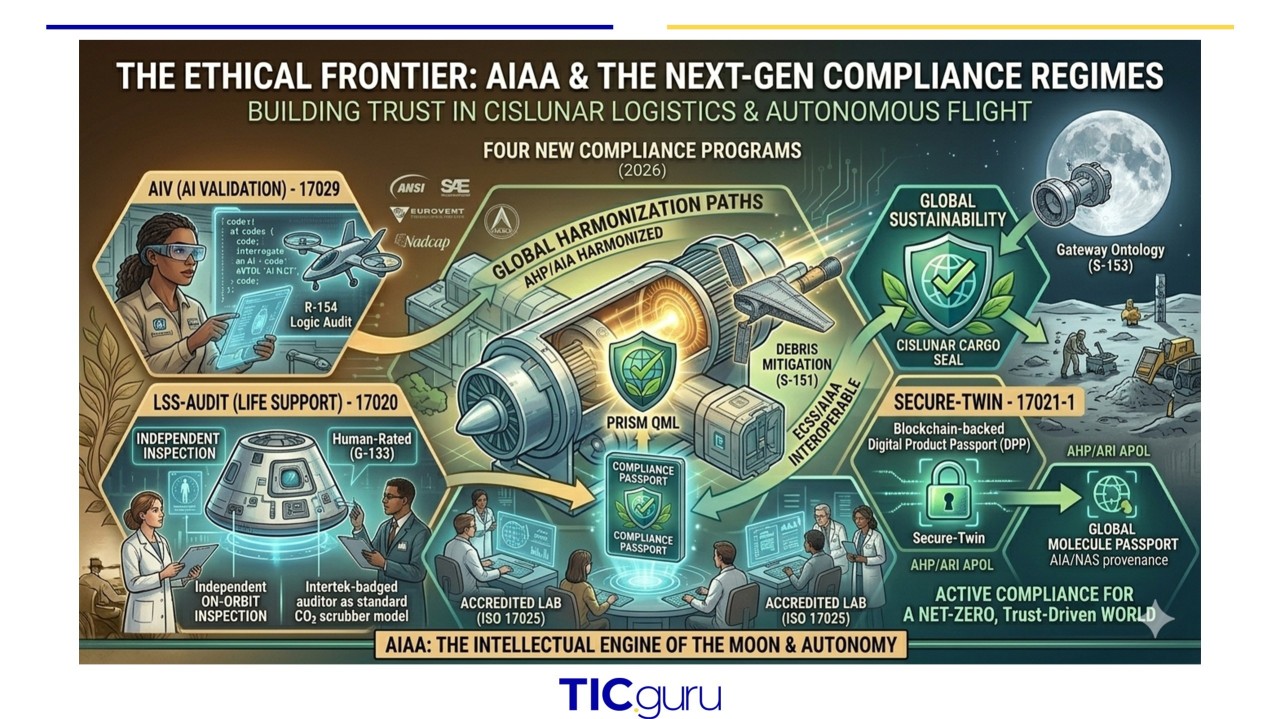
Below are four "Next-Gen" compliance programs developed through the lens of specific ISO/IEC (CASCO) standards, designed to push the boundaries of the AIAA/AIA framework.
Gemini said
This LinkedIn article is designed to position you at the intersection of aerospace engineering and global compliance. It synthesizes the "math-heavy" nature of AIAA with the "trust-heavy" framework of the ISO/IEC (CASCO) family.
LinkedIn Article Draft
Title: Beyond the Bolts: Why the "Math" of Flight is the New Frontier of Global Compliance
The 2026 Inflection Point For decades, the aerospace industry has been defined by physical parts. If the bolt fit and the metal held, we were cleared for takeoff. But in 2026, as we pivot toward Cislunar Logistics, Autonomous Air Mobility (AAM), and Digital Twins, the "invisible" logic behind the hardware has become our most critical asset.
Enter the American Institute of Aeronautics and Astronautics (AIAA).
While other SDOs provide the "hardware" blueprints, AIAA provides the "Scientific DNA." From the AIAA S-153 human spaceflight ontology to the AIAA R-141 CFD verification protocols, these publications are the "Source of Truth" for the next century of exploration.
The CASCO Bridge: Turning Science into Trust The real magic happens when we view AIAA through the lens of the ISO/IEC (CASCO) family of standards. We are seeing a shift from "Build-and-Test" to "Validate-and-Verify."
- ISO/IEC 17029 (Validation & Verification): Using AIAA R-141, we are now validating Digital Twins to reduce physical flight testing by up to 50%. We aren't just certifying the plane; we are certifying the math.
- ISO/IEC 17065 (Product Certification): As the Moon becomes a commercial hub, the AIAA S-153 is the basis for the "Lunar Interoperability Seal," ensuring a SpaceX lander can dock with an ESA module seamlessly.
- ISO/IEC 17020 (Inspection): In our urban skies, third-party bodies are now auditing the "AI Brains" of autonomous drones against AIAA R-154 safety logic.
The Path Forward The future of aerospace isn't just about reaching higher altitudes; it’s about deepening our layers of trust. By integrating rigorous scientific standards into global conformity assessment programs, we ensure that as the industry scales, safety remains uncompromised.
#AIAA2026 #AerospaceEngineering #CASCO #DigitalTwin #SpaceEconomy #Artemis #AutonomousFlight #GlobalCompliance #SDO #Interoperability
The AIAA Power List
1. The SDO & Scientific Leadership
- Of course American Institute of Aeronautics and Astronautics – The primary source.
- Clay Mowry (CEO, AIAA) – Driving the "Technologies Transforming Aerospace" roadmap.
- Davide Petrillo (Lead, AIAA EMEA) – Key for the transatlantic Turin-hub discussions.
- Dan Dumbacher (Executive Director Emeritus) – For his legacy in the 1963 merger vision.
2. The "Adopters" (Primes & Visionaries)
- NASA - National Aeronautics and Space Administration & NASA NCAS Artemis Green – The primary partner for cislunar ontology (S-153).
- SpaceX & Blue Origin – Utilizing AIAA pressure vessel and space power standards.
- Axiom Space – Every commercial module they launch is a victory for AIAA interoperability.
- Joby Aviation & Archer Bravo Aviation – Leaders in implementing AIAA G-136 for battery safety in eVTOLs.
- Boom Supersonic – The poster child for AIAA R-141 digital verification.
3. The "Trust Builders" (Conformity Bodies & Accreditors)
- Intertek – The global leader in ISO/IEC 17029 validation for CFD.
- UL Solutions – The primary certifier for AIAA G-136 (Battery Safety).
- TÜV SÜD – Leading the charge on AIAA S-122 Space Power certifications.
- A2LA (American Association for Laboratory Accreditation) – The accreditor of the labs testing these high-level theories.
- ANAB - ANSI National Accreditation Board (ANSI National Accreditation Board) – The backbone of US conformity assessment oversight.
4. The Global Partners
- European Space Agency - ESA – Specifically for the ECSS/AIAA harmonization.
- Thales Alenia Space – Key partner in the Italian/EMEA aerospace corridor.
- JAXA: Japan Aerospace Exploration Agency – Partners in ISO/TC 20/SC 14.
#AIAA2026 #SpaceEconomy #Cislunar #Artemis #DigitalTwin #FutureOfFlight #AeroEngineering #CASCO #NASA