From Pearl Street to 2026: Why the AEIC Standard is the "Premium Layer" of the Global Grid
In 1885, Thomas Edison’s closest associates met to solve a crisis: the early electric grid was a chaotic "Wild West." They formed the AEIC (Association of Edison Illuminating Companies) to create a unified technical "operating system" for the world's first power companies.
Today, in 2026, that legacy is the bedrock of our modern life. While other standards provide the "minimum" requirements, AEIC provides the "Premium Layer" for utilities that plan in half-centuries, not fiscal quarters.
The "Hierarchy of Stringency"
Why do the world’s leading Investor-Owned Utilities (IOUs) insist on AEIC?
- Beyond the Minimum: While ICEA sets the manufacturing floor and IEEE provides the engineering theory, AEIC CS8 and CS9 are the elite procurement specs.
- The 25% Delta: AEIC standards often require 25% more insulation or more rigorous Partial Discharge (PD) testing than global minimums. This is the difference between a cable that lasts 20 years and one that lasts 60. (Aha! how do you like this as a article start?)
History in the Comic Strip
Do you like this style?
Founded in 1885 by Thomas Edison’s own associates, AEIC isn't just a standards body; it is an elite technical brain trust for the Investor-Owned Utility (IOU) industry. While IEEE writes broad engineering guides, AEIC writes the strict procurement and operation specs that ensure a high-voltage cable buried under New York City doesn't fail for 50 years.
The Core Power: Underground Cable Specs
AEIC is most famous for its Cable Engineering Committee (CEC). If you are a utility engineer in 2026, you don't just "buy a cable"; you buy a cable that meets AEIC CS8 or CS9.
AEIC is unique because it isn't just a standards developer; it's a "User Group" for the biggest power companies. When they write a standard, it’s not an "average" industry guideline—it’s a high-performance specification designed to protect assets that utilities plan to keep in the ground for 50 to 100 years.
In 2026, AEIC’s standards portfolio has expanded to tackle the "Trilemma" of the modern grid: Extreme Reliability, Renewable Integration, and Human Safety.
I am going to list these standards with one of the lens' of the TIC industry. We will look at CASCO again. KEMA Labs SGS Intertek UL Solutions
The Global Map of Power Standards
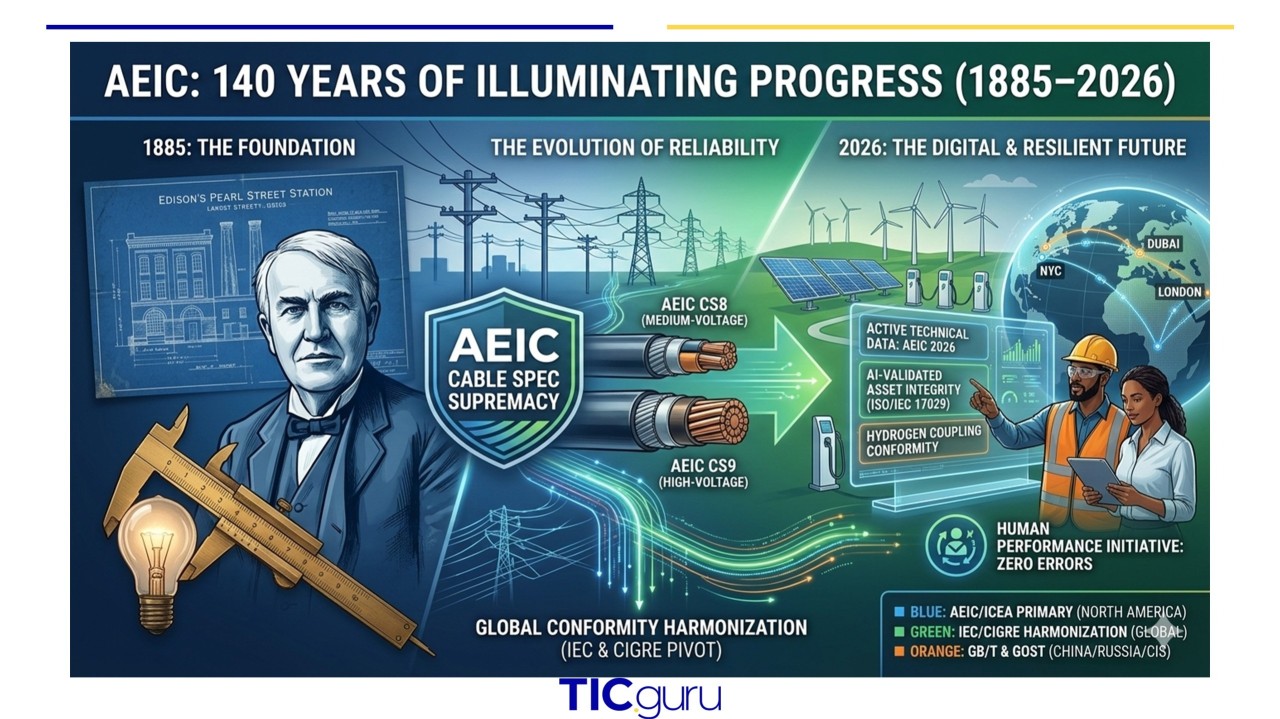
While AEIC is the dominant force in North America, the rest of the world follows a slightly different "technical religion." In the power industry, the "great divide" is between the AEIC/ICEA ecosystem (North America) and the IEC (International Electrotechnical Commission) ecosystem (the rest of the world).
In 2026, the landscape is defined by three major "Standards Blocs." Check Out this picture, with the help of 'you know who' :)
Which one do you use?
- Developing a Project in the USA? You use AEIC CS8/CS9. If you use IEC, your insurance company or the utility commission might reject the installation.
- Building a Wind Farm in the North Sea? You use IEC 63026 (Submarine Cables) and CIGRE CIGRE TB 496.
- Manufacturing in India or the UAE? You strictly follow IEC (International Electrotechnical Commission) , as it allows for the widest export market and project financing (e.g., World Bank projects often mandate IEC).
The CASCO Lens on AEIC: Mapping the Toolbox
The CASCO Value Chain: From Factory to Grid
To visualize how these programs create progress, imagine a high-voltage cable journeying through this new 2026 framework:
- Validation (17029): The cable's design is "Climate-Validated" to survive the year 2050.
- Certification (17065): The factory is certified to produce the "Premium Layer" AEIC specs consistently.
- Continuous Inspection (17020): During production, AI sensors verify the Partial Discharge levels in real-time, issuing a Digital CoC (Certificate of Conformity).
- Field Verification (17020): During installation, pulling-tension data is uploaded to verify the cable wasn't "over-stressed" according to AEIC CG5.
Calling on with some examples and name some like UL Solutions KEMA Labs Kinectrics Bureau Veritas DEKRA TÜV SÜD Eurofins
Looking Ahead
Let us make programs that are designed to solve 2026’s biggest grid challenges: Climate Change, Digital Twins, and Renewable Chaos. If you are offering this, tag us
The 2026 Power Grid List
Key Organizations & Leadership:
- AEIC (Association of Edison Illuminating Companies)
- Elizabeth Cook, PhD (VP of Technical Strategy, AEIC - Driving Grid Modernization)
- Steve Hauser (CEO, AEIC - Leading Infrastructure Transformation)
- Edison Electric Institute (Edison Electric Institute)
- CIGRE (The Global Technical Council)
- IEEE Power & Energy Society
The Utility Titans:
- Southern Company (Pioneers in generation reliability)
- Con Edison (Leaders in Human Performance & Urban Cable Specs)
- NextEra Energy, Inc. y (Driving Renewable Integration Standards)
- Duke Energy Corporation & Exelon (Grid Resilience Innovation)
The TIC & Manufacturing Leaders:
- UL Solutions (Leading the High Voltage Field Testing Program)
- KEMA Labs (CESI) (The global "Gold Standard" for EHV Type-Testing)
- Kinectrics (Specialists in high-voltage forensics and field diagnostics)
- Southwire Company & Prysmian Group (Primary manufacturers of AEIC-spec cables)
- SGS & Intertek (The gatekeepers of Global Factory Assurance)
Hashtags: #AEIC2026 #PowerGrid #UtilityEngineering #SmartGrid #EnergyTransition #HighVoltage #GridResilience #ISO17029 #HumanPerformance #EdisonLegacy