
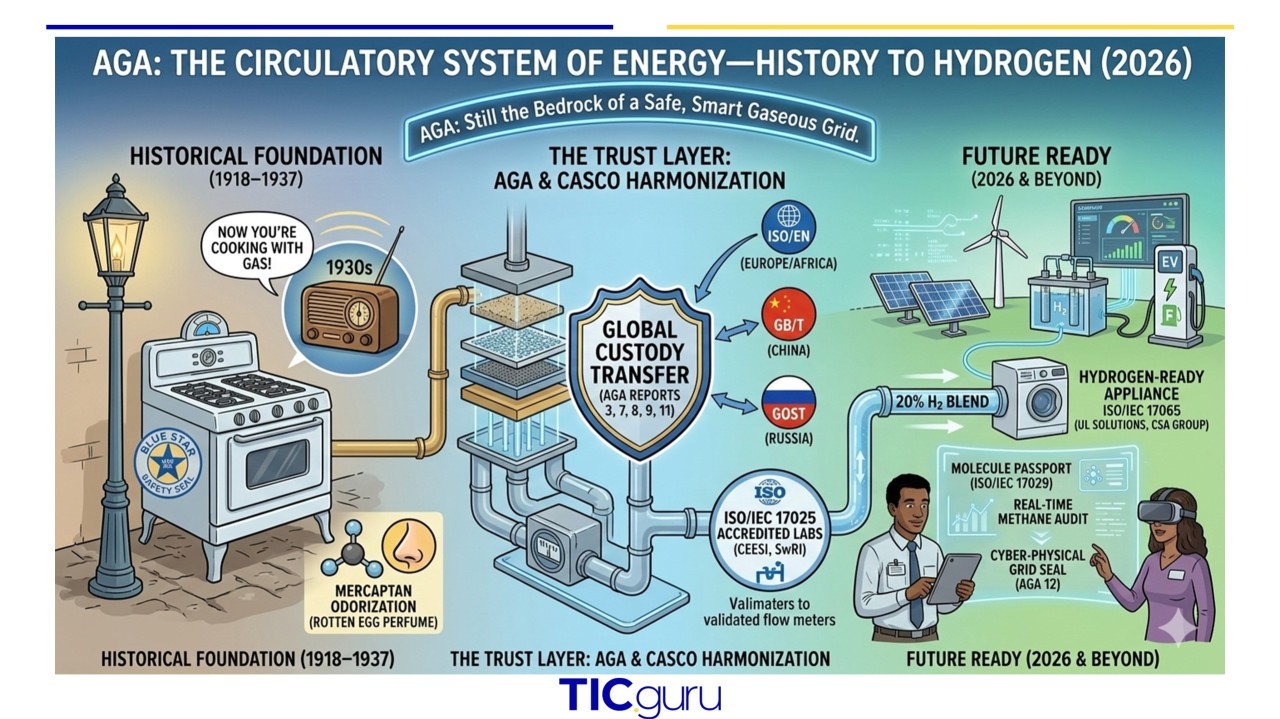
While the electrical grid gets the headlines, the American Gas Association (AGA) has spent over a century building the invisible "circulatory system" that powers 189 million Americans.
The Circulatory System of Energy bridges the gap between 100 years of history and the high-tech, hydrogen-ready future of the American Gas Association (AGA).
Lets start with
The Historic Journey
From the The Great Merger of 1918 to the The Rotten Egg "Perfume" (1937) and more. Check out the cartoon strip and reach out to me if you want to know what more I dug up :)
Historical Snippets: The "Did You Know?
One of the most interesting "hidden" histories of the AGA is the Gas Appliance Improvement Network (GAIN). Launched to share incident data between manufacturers and utilities, it created a "Continuous Improvement" loop. If a specific regulator failed in cold weather in Minnesota, the data was shared through AGA to ensure every utility in the country knew how to fix it—a culture of transparency that is rare in other industries
The AGA Technical Pillars
The publications can be divided into groups
- The "Cash Registers" (Measurement)
- The "Brain" (Thermodynamics)
- The "Circulatory System" (Infrastructure)
- The "Green Guard" (Quality & Environment)
- The "Digital Shield" (Cybersecurity)
Lets look into a table form and I will let you imagine how below get grouped into above :)!
Is AGA is "Winning" Globally
Even in regions that officially use ISO, you will almost always find AGA 8 being used in the background. Because it is the most accurate way to calculate the "supercompressibility" of gas, it has become the "mathematical language" of the global gas industry, even if the physical pipes are built to local standards.
Lets see this to understand better
The global landscape is generally split into four major "zones" based on which technical documents govern the infrastructure:
1. The AGA Core (North America)
- Regions: USA, Canada, Mexico.
- Standard: AGA Reports are mandatory and ubiquitous.
- Key Docs: AGA 3 (Orifice), AGA 7 (Turbine), AGA 9 (Ultrasonic), and AGA 8 (Compressibility). In the U.S., these are often integrated into federal regulations (PHMSA) and private contracts.
2. The ISO/EN Stronghold (Europe & Africa)
- Regions: European Union, UK, Norway, and much of Africa.
- Standard: ISO 5167 and EN 12261.
- Context: Europe relies heavily on the MID (Measuring Instruments Directive). While the math is similar to AGA, the mechanical tolerances and installation requirements follow the International Organization for Standardization (ISO).
3. The "Fiscal Allies" (Middle East, South America, SE Asia)
- Regions: Saudi Arabia, UAE, Brazil, Argentina, Indonesia, Malaysia.
- Standard: Hybrid (AGA/API dominant).
- Why: Because these regions focus heavily on exporting LNG and oil, they adopt the standards used by their biggest customers and partners (often US-based). Saudi Aramco, for instance, largely builds its measurement stations to AGA 9 (Ultrasonic) specifications for high-volume exports.
4. Sovereign Standards (China & Russia)
- Regions: China, Russia, CIS countries.
- Standard: GB/T (China) and GOST (Russia).
- Context: These nations have historical, state-mandated standards. However, modern revisions of China's GB/T 18603 are increasingly "harmonized" (identical or equivalent) to ISO standards to facilitate global trade.
Beyond the Pipe: How ISO/IEC 17000 is Modernizing Gas Infrastructure
Moving gas is a game of data. By applying the ISO/IEC 17000 (CASCO) "Trust Toolbox" to AGA standards, the industry is transforming "iron pipes" into "digital assets."
Lets look at a map of Cabs and users. SGS CEESI (Colorado Engineering Experiment Station Inc.) SwRI Machinery and Power Systems TÜV SÜD Hoffer Flow UL Solutions CSA Testing & Certification Intertek AGA Bureau Veritas Gexcon NDT Global DNV Lloyd's Register ERM CVS Enbridge TC Energy Kinder Morgan, Inc. Williams Lennox Rheem Manufacturing Company Carrier Bosch Samsung Research SoCalGas Pacific Gas and Electric Company PG&E, LLC Southern Company Gas National Grid US Environmental Protection Agency (EPA)
To push the American Gas Association (AGA) into the future, we need to stop looking at pipes as "dumb iron" and start looking at them as a high-tech data network. By applying the ISO/IEC 17000 (CASCO) toolbox to the AGA’s deep library of reports, we can create a "Trust Layer" for the energy transition.
In 2026, the real money isn't just in moving gas—it's in proving that the gas is clean, the pipes are ready for Hydrogen, and the sensors aren't lying.
Lets imagine the future
The AGA-CASCO Innovation Matrix
Flagship Opportunities
1. The "H2-Ready" Network Validation (ISO/IEC 17029)
- The Problem: Utilities are terrified that Hydrogen will make their pipes brittle (Hydrogen Embrittlement).
- The Opportunity: Create a Validation Scheme where a TIC company (like DNV or Bureau Veritas) uses AGA XR0603 criteria to audit a utility's pipe material records.
- The Progress: A "Validated" network can be insured at lower rates and attracts "Green Bond" investment.
2. Real-Time Methane "Zero-Leak" Certification (ISO/IEC 17020)
- The Problem: Traditional "boots on the ground" leak detection is too slow.
- The Opportunity: A move from periodic inspection to Automated Remote Inspection.
- The Tech: Certification bodies can "accredit" an AI-driven drone or satellite system to act as a Virtual Inspector. If the system follows AGA GPC protocols, its data can automatically update the utility’s compliance status.
- The Progress: This creates a "Live Compliance Dashboard" for regulators, replacing the 100-page annual report.
3. The "Smart Gate-Station" Cybersecurity Seal (ISO/IEC 17067)
- The Problem: As gate stations (where gas enters the city) become "Smart," they become targets for hackers.
- The Opportunity: Using AGA Report No. 12 (which covers cryptographic protection), develop a specialized Cyber-Physical Product Certification.
- The Progress: Manufacturers (like Emerson or Honeywell) would submit their "Smart Metering Skids" for testing. If it passes, it gets a "Global Gas-Grid Security Seal," making it the preferred choice for all major IOUs.
I am shying from tagging the people in this one. Should I?
#AGA2026 #NaturalGas #HydrogenEconomy #EnergyTransition #GridModernization #Metrology #Sustainability #ISO17029 #CleanEnergy #Infrastructure