If American Concrete Institute is the "structural architect" of our cities, the American Dental Association (ADA) is the "chief engineer" of the human smile. Founded in 1859, it is the world’s oldest and largest national dental society.
In 2026, the ADA has moved far beyond just recommending "brushing twice a day." It is now the global gatekeeper for Artificial Intelligence in diagnostics, 3D-bioprinting of enamel, and the critical Oral-Systemic health link (how your teeth affect your heart).
The ADA Chronicles: From Barbers to Bioprinting
In 2026, the ADA has moved far beyond just recommending "brushing twice a day." It is now the global gatekeeper for Artificial Intelligence in diagnostics, 3D-bioprinting of enamel, and the critical Oral-Systemic health link (how your teeth affect your heart).
The ADA represents over 161,000 dentists and is the primary source of dental standards in the USA, heavily influencing global practices through its work with ISO/TC 106 (the international technical committee for dentistry).
The ADA "Seal of Acceptance"
Since 1931, this has been the most recognized consumer "Trust Mark" in healthcare. In 2026, getting this seal requires more than just clinical trials; it requires rigorous data on biocompatibility and microplastic-free composition.
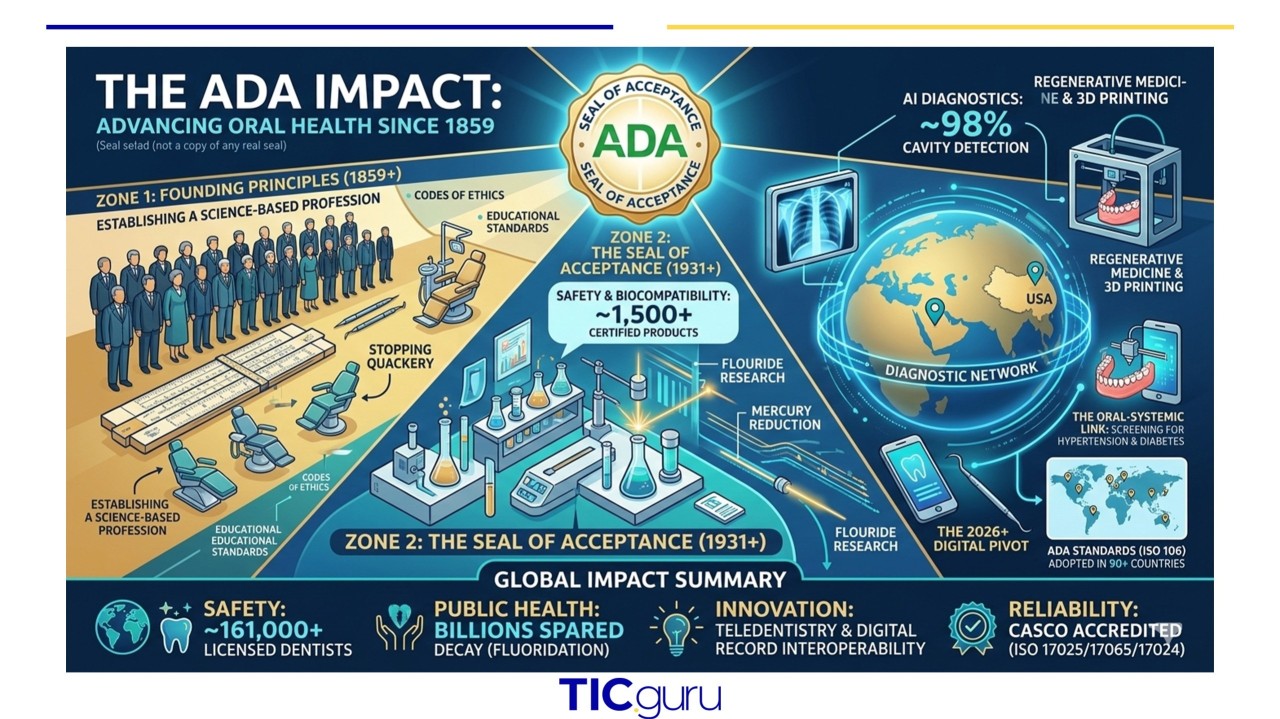
Before we look at the major standards, lets read through the comic strip, AI helped me create. Actually I created two, but chose this one. LMK if you want to see the other :)
The Technical Blueprint: Major Standards
the ADA has moved into a highly granular era of standardization. While the core "Seal of Acceptance" remains the consumer anchor, the technical backend has been reorganized into 12 New Consensus Bodies to handle the explosion of digital and biological technology. Would you like to know of these 12 Consensus Body (CB)? and what are their focus?
Here are the additional, high-value standards and technical reports defining dentistry in 2026.
I. The Digital & AI Frontier (SCDI - Informatics)
These standards govern how dental software "thinks" and talks to other health systems.
- ANSI/ADA Standard No. 1110-1:2025 (The AI Image Standard): The first official U.S. standard for AI in dentistry. It sets strict protocols for how 2D radiographs must be annotated to train diagnostic AI.
- ADA Technical Report No. 1109:2025 (Evaluating AI Accuracy): A guide for dentists to evaluate if an AI tool is biased. It requires manufacturers to test their software against independent "Ground Truth" datasets.
- ANSI/ADA Standard No. 1084 (Core Data Set): Newly released for review in 2026. It defines the "Common Electronic Dental Record" so your dental history can move seamlessly between different software brands without losing data.
- ADA Standard No. 1120-3 (Dental Plan Interoperability): Standardizes how insurance coverage information is coded, aimed at ending the "hidden cost" surprises during patient check-out.
- ADA Technical Report No. 1077 (Teledentistry): Defines the security and video quality requirements for virtual consultations, ensuring your "Zoom-dentist" is as secure as an in-person visit.
II. Advanced Materials & Lab Safety (SCDP - Products)
These standards focus on the "wet-lab" side of dentistry—what actually goes into your mouth.
- ANSI/ADA Standard No. 216 (Endodontic Irrigants): A 2026 standard that classifies the liquids used to clean out root canals, ensuring they are biocompatible and don't weaken the tooth structure over 30 days.
- ANSI/ADA Standard No. 173 (Fluoride-Releasing Materials): Governs "Smart Fillings" that sense when your mouth is too acidic and release protective ions to prevent a second cavity.
- ADA Standard No. 1111 (3D Printing Resins): (Currently in finalization for 2026) This standard regulates the toxicity and "wear-resistance" of resins used to 3D-print permanent crowns and bridges right in the dental office.
- Standard No. 41 (Biological Evaluation): The definitive manual for testing "Implant-Bone Integration." It dictates how titanium and ceramic implants are tested for long-term survival in human bone.
III. The "Green" & Sustainable Standards (2026)
Sustainability has moved from a "suggestion" to a standardized metric in 2026.
- ADA Sustainability Appendix (2025): New guidelines for "Dry-Vacuum Systems." Legacy systems used hundreds of gallons of water daily; the new standard mandates water-free vacuums.
- Standard No. 109 (Amalgam Separators): Strengthened in 2024 to ensure 99% of mercury waste is captured before it reaches city water systems.
- The "Eco-Operatory" Specification: A new technical report recommending the phase-out of single-use plastic barriers in favor of high-level disinfectants that are biodegradable.
Global Reach
While "American" is in the name, the ADA’s Science & Research Institute (ADSRI) in Gaithersburg, MD, conducts research used by dental associations in over 90 countries. If a new filling material is safe in Chicago, it’s usually because it passed an ADA-pioneered test used by labs in Singapore and Zurich.
The Assurance Industry
In the dental world, conformity is split between consumer trust (the product on the shelf) and professional competence (the dentist and the lab). In 2026, these programs are more digital and data-driven than ever.
Here are the primary conformity programs and the bodies that execute them based on ADA standards.
I. Product Conformity: The ADA Seal Program
This is the most direct application of ADA standards to the physical world. It is run directly by the ADA but relies on third-party data.
ANSI - American National Standards Institute , @ADSRI
II. Personnel & Laboratory Certification
These bodies ensure that the individuals and labs providing dental services meet the high-bar standards of the profession.
III. Digital & AI Validation (The 2026 Frontier)
With the rise of AI, new "Validator" bodies have emerged to run programs based on the ADA 1100 series of informatics standards.
- The ADA-Informatics Validation Program: Run by the ADA Standards Committee on Dental Informatics (SCDI), this program verifies that dental software (PMS) can correctly export the ADA 1084 Core Data Set.
- Third-Party AI Auditors (e.g., SGS, Intertek): While the ADA sets the standards (Standard 1110), global TIC companies now run "AI Quality Audits" to verify that diagnostic software meets ADA accuracy benchmarks before it hits the clinic.
IV. International Alignment: The ISO Bridge
Because the ADA is the "U.S. National Member Body" to ISO/TC 106 (Dentistry), many international programs are essentially running ADA-originated science.
- The Dental Schools Association of Asia (DSAA): Frequently adopts ADA-based accreditation standards for regional consistency.
- European Committee for Standardization (CEN): Works with the ADA to harmonize standards for dental implants, often using the ADA Standard No. 41 protocols for biological evaluation.
The "Opportunity Gap": Underused Conformity Programs
For businesses looking to lead in 2026, these underutilized areas represent high ROI:
- ISO/IEC 17029 (Validation of Sustainability Claims): The ADA has new "Green Operatory" guidelines. A body that starts a formal "Validated Green Practice" program based on these will own the eco-conscious market.
- ASTM/ADA 3D Printing Certification: As more dentists print teeth in-office, there is a massive need for a program that certifies In-Office Manufacturing Processes to ensure they don't bypass safety protocols.
Traditional TIC Players in the ADA Ecosystem
The traditional "Big Five" of the TIC (Testing, Inspection, and Certification) world—SGS, Intertek, Eurofins, TÜV SÜD, and Bureau Veritas—are heavily active in the dental conformity space in 2026.
However, they don't just "test toothpaste." They operate at the intersection of ADA science and Global Medical Device Regulations (like the US FDA and EU MDR). Here is the AI breakdown (Of course you can contest everything here ;))
Key names in the ADA Ecosystem
American Dental Association ADA Science & Research Institute (ADSRI); National Institute of Dental and Craniofacial Research (NIDCR at NIH) ; Dentsply Sirona ; Henry Schein ; OVERJET
Dr. Brett Kessler Dr. Raymond Cohlmia Dr. Marcelo Araujo Dr. Ward Blackwell Dental Leaders Academy
#ADA2026 #DentalInnovation #DigitalDentistry #OralSystemicLink #DentalAI #HealthcareStandards #ANSI #ClinicalExcellence
In the end query , "The integration of #ICD10 codes into the #CDT2026 manual marks a turning point for the profession. I'd love to hear from Dr. Marko Vujicic on how this shifts the economic value of the dental practice, and Wardah Inam on how AI-driven diagnostics will support this new primary care role."