
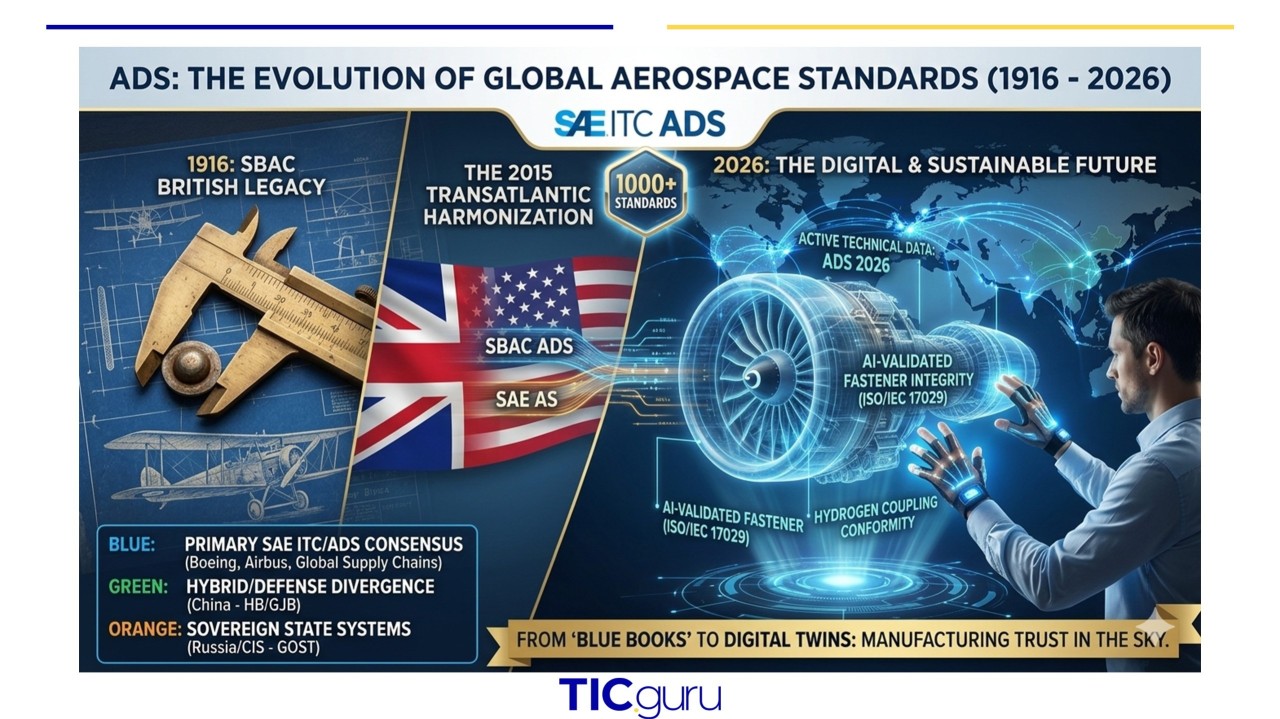
From 1916 Rivets to 2026 Digital Twins: The Transatlantic Journey of Aerospace Design Standards (ADS)
Have you ever wondered why a bolt manufactured in a small factory in Malaysia fits perfectly into a wing spar assembled in France, destined for an aircraft maintained in Dubai?
The answer isn't just "engineering"—it’s a century-old technical "operating system" called ADS (Aerospace Design Standards) the SAE Industry Technologies Consortia (SAE ITC)—an affiliate of SAE International —ADS is a collection of over 1,000 highly specialized technical standards that ensure every bolt, rivet, and fluid in an aircraft performs with 100% reliability at 35,000 feet.
A Tale of Two Continents: The History
The story of ADS is one of Transatlantic Convergence. It began in 1916 London, born of wartime necessity. The Society of British Aerospace Companies (SBAC) realized that non-interchangeable parts were grounding the Royal Flying Corps. They created the "Blue Books"—the definitive standards for the British Commonwealth.
Fast forward to January 1, 2015: In a historic strategic move, technical ownership of these 1,000+ standards transferred from the UK’s ADS Group to the US-based SAE Industry Technologies Consortia
The Result? A unified global language. The legacy British "L" and "AS" series were digitized and harmonized with American specs, creating the most granular technical repository in aviation history.
The Technical Blueprint: What is an ADS Standard?
Unlike broad "safety guides," ADS standards are often dimensional and material blueprints. They tell a manufacturer exactly how to make a specific part so it is interchangeable across different aircraft.
Here is a summary table .
Global Adoption Map: The Three Major Blocs
The global adoption of aerospace standards in 2026 is a study in harmonization vs. sovereignty. While the SAE ITC (ADS/AS) and IAQG (AS9100/IA9100) standards dominate the Western and commercial markets, regional powerhouses like China and Russia maintain their own systems to ensure strategic independence.
Understanding the 'The Conformity Engine'
The ADS standards are unique because they are backed by the most rigorous "Special Process" audit system in the world: NADCAP. But there is more to this. The industry has moved from simple "factory inspections" to Continuous Digital Oversight. In 2026, the ADS standards (managed by SAE ITC) provide the technical "DNA," while a massive network of TIC (Testing, Inspection, and Certification) players acts as the "immune system" of the supply chain.
The "Big Three" Compliance Programs
These programs are the "engines" that run on ADS technical data. They ensure that every part—from a titanium bolt to a flight-control sensor—is authentic and high-performing.
The TIC Ecosystem: The Giants & The Specialists
The aerospace TIC market is worth over $40 Billion in 2026, split between generalist titans and niche specialists.
The "Global Giants"
Here are examples of players handle high-volume certifications (like AS9100) and global supply chain audits. Of course, these are AI supported intelligence gathering and can be contested.
- SGS : The leader in global AS9100/9110/9120 certifications. They have the largest worldwide network for auditing ADS-compliant factories in 2026.
- Intertek : Dominates Product Testing. They run the massive labs that stress-test ADS fasteners and seals against extreme "Cycles to Failure."
- Bureau Veritas : Specializes in Digital & Cybersecurity Compliance. In 2026, they audit the "Digital Twin" models used in SAE ITC’s Digital Standards Alliance.
- TÜV SÜD : The experts in Active Hardware. They certify the electronics and sensors (ESC series) that must survive turbine-level heat.
- Eurofins : Focuses on the Chemical & Material side (AMS specs), testing for hazardous substances in the newer Sustainable Aviation Fuels (SAF).
The "Niche Specialists" (Critical to the ADS Chain)
These are smaller or highly focused players that possess deep technical mastery of specific ADS series.
- Element Materials Technology : Perhaps the most specialized "Mid-Tier" player. They are the world leaders in Materials Testing for aerospace alloys.
- MISTRAS Group : Specialists in Non-Destructive Testing (NDT). They use ultrasound and X-ray to ensure an ADS-spec wing spar has no internal cracks.
- BSI (British Standards Institution): Maintains a deep legacy link to the "British" origins of the ADS series, acting as a primary auditor for UK-based aerospace hubs.
- NSF - Food and Nutrition International : A major player in the AS9100 series, specifically focusing on the integration of Risk Management into the manufacturing floor.
The biggest shift in 2026 is the move from ISO/IEC 17025 (Lab Testing) to ISO/IEC 17029 (Validation and Verification).
- Continuous Monitoring: Instead of one audit per year, TIC players like SGS and Intertek now use "Remote Sensor Auditing." They monitor factory data in real-time to ensure the heat-treatment of a batch of ADS bolts never fluctuates outside the allowed TS (Technical Spec) range.
- Traceability: Every part in the TS200 database now has a "Digital Passport." If a plane in Singapore has a faulty seal, the system can instantly trace the exact ADS spec, the batch number, and the TIC inspector who cleared it in France.
Now and the Future Opportunities
To move the aerospace industry forward in 2026, ISO/CASCO standards are no longer just about static audits; they are becoming the framework for a "Live Compliance" ecosystem. By leveraging the 17000 series, we can suggest three transformative programs that would solve the current bottlenecks in sustainability, AI, and digital twins.
(The Aerospace Power List)
Key Organizations:
- SAE Industry Technologies Consortia (SAE ITC)
- ANSI - American National Standards Institute (ANSI)
- PRI | Performance Review Institute (PRI)
- Airbus & Boeing
- ADS Group Ltd (UK)
- INTERNATIONAL AEROSPACE QUALITY GROUP (IAQG)
The TIC Industry Leaders:
- SGS (Global AS9100 Leadership)
- Intertek (Product Testing & ADS Seal validation)
- Bureau Veritas (Digital & Cybersecurity Standards)
- Element Materials Technology (The Materials Specialists)
- TÜV SÜD (Hardware & Sensors)
Key People to Follow:
- Darcyne Foldenauer (Executive Director, SAE ITC)
- David Alexander (Senior Director, Aerospace Standards at SAE)
- Laurie Strom (COO, SAE ITC - Leading Additive Manufacturing)
- Simon Powell (Lead, Digital Standards Alliance)
Hashtags: #AerospaceEngineering #ADS2026 #SAEITC #AviationSafety #SupplyChain #NADCAP #ISO17029 #DigitalTwin #Sustainability #MRO #QualityAssurance