
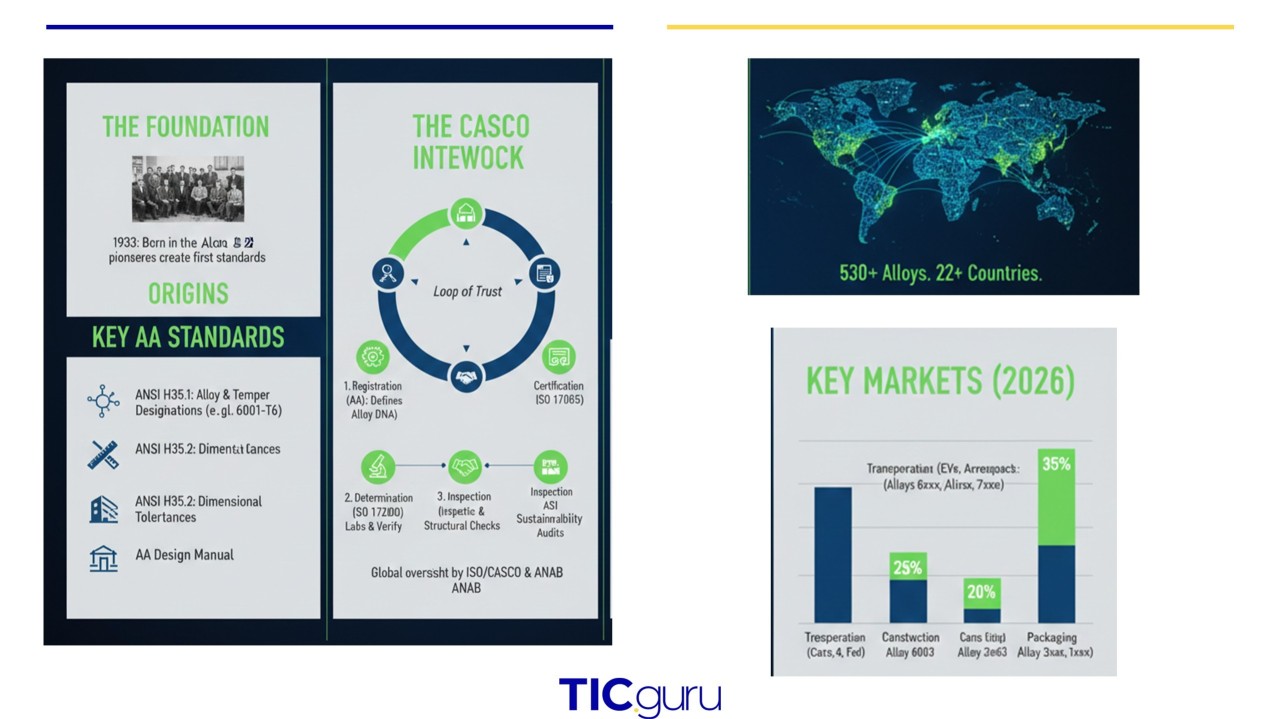
In the world of materials science, precision isn't just a goal—it’s a requirement. Whether it’s an aircraft wing soaring at 35,000 feet or the beverage can in your hand, the reliability of that product depends on a universal language. That language is the Aluminum Association (AA) Standards. The Aluminum Association
As we navigate 2026, the AA standards remain the "Gold Standard" (or should we say "Aluminum Standard") for the industry, providing the essential framework for alloy composition, temper, and nomenclature across the globe
The Great Depression to Global Dominance: The Origins
The Aluminum Association (AA) was born out of necessity in 1933. During the Great Depression, 13 pioneering companies met to establish codes for fair competition under the National Industrial Recovery Act. Led by visionaries like Arthur Vining Davis of Alcoa, the group realized that for aluminum to become a modern industrial pillar, it needed a standardized system of identification.
What started as 75 unique compositions has grown into a registry of over 530 active alloys, making aluminum one of the most versatile materials on the planet.
The Registry of Excellence: Key AA Standards
The AA’s "Colored Sheets" (The Teal, Pink, and Rainbow Sheets) are the industry's most cited references. At the heart of this system are the ANSI H35 standards:
- ANSI H35.1 (Alloy & Temper Designations): The most famous system in the world. It’s why an engineer in Dubai and a fabricator in Detroit both know exactly what 6061-T6 means.
- ANSI H35.2 (Dimensional Tolerances): The "Bible" of precision, defining the allowable deviations for sheets, plates, and extrusions.
- Aluminum Design Manual (ADM): The structural engineer’s go-to for building skyscrapers, bridges, and infrastructure with aluminum.
The CASCO Pivot: A Network of Global Trust
The AA doesn't just work in a vacuum; it is the cornerstone of a massive, interconnected network powered by the ISO/CASCO (Committee on Conformity Assessment) toolbox.
The relationship between the AA and CASCO creates a "Loop of Trust":
- Registration (AA): The AA acts as the Registration Authority, defining the chemical DNA of the alloy.
- Determination (ISO/IEC 17025): Accredited laboratories use ISO/IEC 17025 to test and prove that a piece of metal matches the AA’s registered composition.
- Inspection (ISO/IEC 17020): Inspection bodies verify that structural aluminum used in construction meets the AA Design Manual requirements.
- Certification (ISO/IEC 17065): Modern sustainability schemes like the Aluminium Stewardship Initiative (ASI) use ISO/IEC 17065 to certify that AA-standard metal is produced ethically.
A Global Passport: Market Reach in 2026
Today, the reach of AA standards is truly borderless:
- Countries: While rooted in the USA, the system was adopted by the International Signatories of the Declaration of Accord in 1970. Today, China, India, Germany, and the UAE are among the largest users.
- Accreditation Bodies: Organizations like ANAB and A2LA ensure that the labs testing AA alloys are technically competent.
- Markets: From Transportation (35%) driven by the EV revolution to Packaging (20%) and Construction (25%), AA standards facilitate billions in trade.
As the industry pivots toward "Green Transformation" and "Intelligent Manufacturing," the Aluminum Association remains the backbone of the system, ensuring that as the world changes, the metal we rely on stays consistent, safe, and sustainable.
#AluminumAssociation #MaterialsScience #StandardsMatter #ISO #CASCO #AerospaceEngineering #AutomotiveInnovation #Sustainability #AluminiumStewardshipInitiative #GlobalTrade
The Aluminum Association Alcoa Arconic Rio Tinto Norsk Hydro Novelis Gränges Group Constellium Kaiser Aluminum Century Aluminum Aluminium Stewardship Initiative ISO - International Organization for Standardization ANSI - American National Standards Institute ANAB - ANSI National Accreditation Board A2LA ASTM International SGS Intertek Bureau Veritas Applied Technical Services, LLC ALCircle Biz Boeing g Airbus Tesla Ford Motor Company