
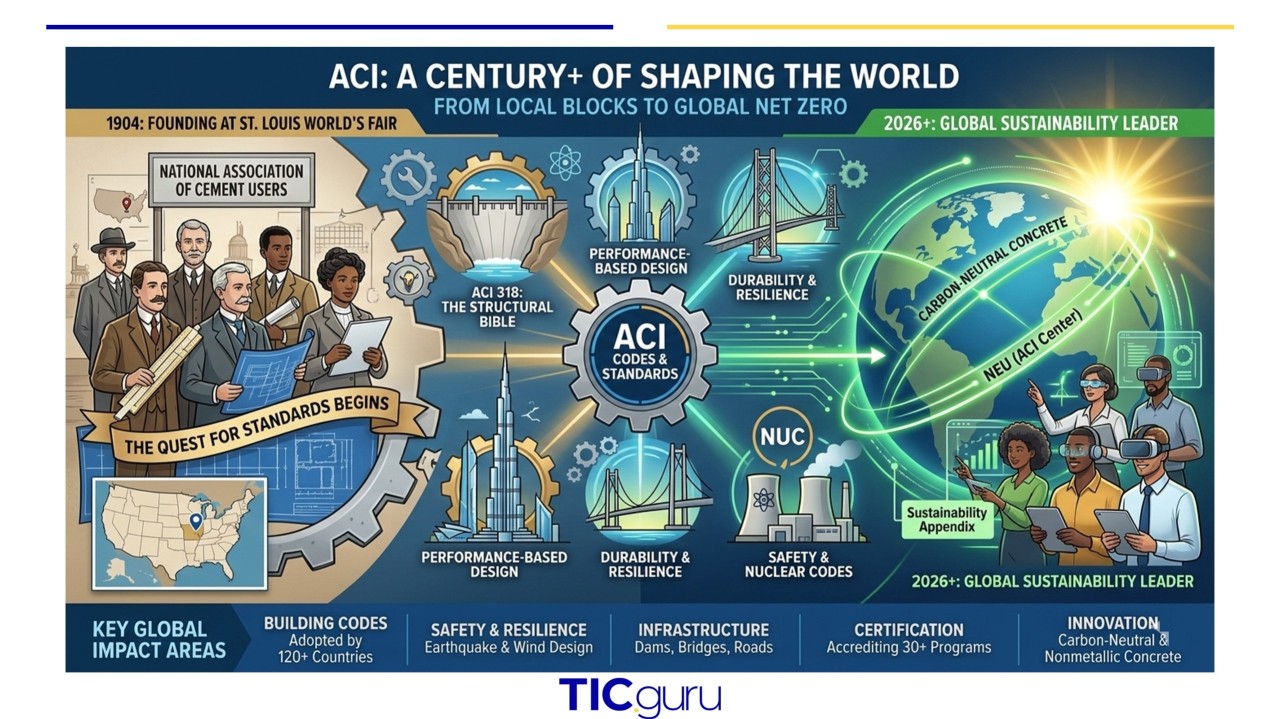
The American Concrete Institute (ACI) is the primary "structural architect" of the modern world. If you live in a skyscraper, cross a bridge, or drive on a highway, the safety of that journey was likely dictated by an ACI code.
As we reach 2026, ACI has moved beyond just "gray blocks" and is now the global leader in Carbon-Neutral Construction and Performance-Based Design
History Snippets: From Reinforcement to Resilience
Shall we get poetic this time?
That was fun right?
To understand the birth of ACI, you have to imagine the "Wild West" of 1904. Construction was booming, but concrete blocks were often crumbling because there were no rules for how to make them
Here are some of the most interesting facts about that pivotal first year:
The Secret Trio Behind the Scenes
The ACI wasnt started by a government mandate; it was started by three enthusiasts who were worried about the unsatisfactory conditions of concrete blocks. Charles C. Brown (an editor of Municipal Engineering magazine) teamed up with A.S.J. Gammon (a machinery manufacturer) and John P. Given (a cement machinery salesman).They essentially used Brown’s magazine as a megaphone to shout:
The First Informal Meeting was at the World’s Fair
The very first sparks of ACI happened in October 1904 at the Louisiana Purchase Exposition (The St. Louis Worlds Fair). During an Engineering Congress at the fair, a small group held an informal meeting to discuss forming an association. Originally, they only wanted to form a club for manufacturers of concrete block machines to teach people how to use them properly. They quickly realized the problem was much bigger than just blocks.
The Identity Crisis NACU
Before it was the ACI, it was the National Association of Cement Users (NACU). The first official convention was held in Indianapolis in January 1905, but the planning and organizational work took place throughout late 1904. The name was changed to the American Concrete Institute in 1913 because Cement Users sounded like they were just people who bought cement, while they were actually the engineers and architects building the future.
The 14-Page Mega-Code
To put into perspective how early this was: the first building code they eventually released (the great-great-grandfather of ACI 318) was only 14 pages long. In 1904, reinforced concrete was considered a new and experimental structural material. Railroads were the early adopters, using concrete for bridges because they needed something that wouldnt rot like wood or rust like iron under heavy loads.
Cincinnati’s Concrete Gamble
Right as ACI was forming in 1904, the world’s first concrete skyscraper, the Ingalls Building in Cincinnati, had just been completed (1903).Critics at the time were so skeptical of concrete that they stayed awake all night when the support forms were removed, expecting the 16-story building to collapse under its own weight. Its survival provided the momentum the ACI founders needed to prove that concrete was a legitimate engineering material.
The Technical Blueprint: Major Standards
ACI manages hundreds of committees that produce the operating system for the construction industry.
- ACI CODE-318-25 (The Big One): Building Code Requirements for Structural Concrete. This is the mandatory standard for design in the US and dozens of other countries. 2026 Update: Includes the first-ever Sustainability Appendix, performance-based wind design, and consolidated rules for deep foundations.
- ACI CODE-562-25: The standard for the assessment, repair, and rehabilitation of existing structures—critical for the 2026 focus on "Adaptive Reuse."
- ACI 301: Specifications for Structural Concrete (the "contract" between engineers and contractors
- Manual of Concrete Practice (MCP): A multi-volume set containing every ACI report and standard, updated annually.
Regions, Industry Segments & Key Users
ACI's reach is truly global, with over 100 chapters and members in 120+ countries.
- Primary Regions: While headquartered in Farmington Hills, Michigan, ACI codes are the backbone of construction in the Middle East (UAE/Saudi Arabia), Latin America, and Southeast Asia.
- Key Industry Segments:
- High-Rise Construction: Utilizing high-strength concrete and seismic detailing.
- Infrastructure: Bridges, dams, and nuclear containment vessels.
- Renewable Energy: Foundations for massive offshore wind turbines.
Some Key Users: Bechtel Corporation , AECOM , Turner Construction Company , and municipal governments like the Dubai Municipality and NYC Department of Buildings .
Quality Assurance
ACI standards are the primary criteria used in Conformity Assessment to ensure that "Concrete on Paper" matches "Concrete on Site."
Some of the key players driving this and may like to see the next section. SGS , Bureau Veritas Intertek (PSI); Terracon ; Fugro ; Al Hoty Stanger Ltd. Co. ; Wimpey Laboratories GPRS CTLGroup
Underused CASCO Standards: The 2026 Opportunity List
While the "Three Pillars" are the industry baseline, the following standards are currently underutilized. Organizations that adopt these in 2026 will lead the market in Sustainability and Advanced Technology.
1. ISO/IEC 17029: Validation and Verification (The "Greenwash" Killer)
- The Opportunity: With the release of ACI 323 (Low-Carbon Concrete), companies are flooding the market with "Net Zero" claims.
- Why it’s a Gap: Most firms use simple marketing; 17029 provides a formal framework to validate future-looking claims (e.g., "This bridge will reach carbon neutrality by 2040") and verify past data.
- Strategic Advantage: Achieving accreditation to 17029 makes your "Green Concrete" report legally bulletproof for ESG investors.
2. ISO/IEC 17065: Product Certification (Beyond the Lab Report)
- The Opportunity: Currently, most concrete is tested batch-by-batch. 17065 allows for the Certification of a Process or Product line (like a specific brand of Precast Panels or 3D-Printed Concrete elements).
- Why it’s a Gap: It moves the focus from "did this cylinder break correctly?" to "does this factory consistently produce ACI-compliant units?"
- Strategic Advantage: Reduces on-site testing requirements and allows for faster "Fast-Track" construction approvals.
3. ISO/IEC 17043: Proficiency Testing (For the Labs)
- The Opportunity: This governs the providers of "Round Robin" testing, where multiple labs test the same sample to see if they get the same result.
- Why it’s a Gap: Many labs claim competence but fail "Inter-laboratory Comparisons."
- Strategic Advantage: Large contractors can use this to vet their supply chain, ensuring that the three different labs on a massive Giga-project are actually calibrated to each other.
4. ISO/IEC 17034: Reference Material Production
- The Opportunity: As we move toward Bio-admixtures and Graphene-enhanced concrete, we need "Standardized Samples" to calibrate machines.
- Why it’s a Gap: There is a shortage of certified reference materials for new sustainable cement alternatives.
- Strategic Advantage: Chemical companies and admixture manufacturers can become "Reference Material Producers," setting the global benchmark for how new materials are measured.
The 2026 Strategic Shift: Green Concrete
The biggest story for ACI in 2026 is the ( NEU: An ACI Center of Excellence for Carbon Neutral Concrete and NEx: An ACI Center of Excellence for Nonmetallic Building Materials
Carbon Neutrality: ACI is leading the push to replace traditional clinker with sustainable alternatives (fly ash, slag, calcined clays) to reduce the 8% of global CO2 caused by cement.
Digitalization: Moving from PDF codes to ACI 318 PLUS, a digital, searchable interface that integrates directly into BIM (Building Information Modeling) software.
Key People & Businesses (2026 Power Players)
Leadership:
- Michael Schneider : Chair of the ACI Foundation Board (Driving innovation).
- Frederick H. Grubbe, MBA, CAE : ACI Executive Vice President.
- Scott Anderson : ACI Vice President ( Keystone Structural Solutions ).
- Matthew Sherman ACI Vice President ( Simpson Gumpertz & Heger (SGH) ).
Businesses Supporting Delivery:
- Master Builders Solutions : Innovation in chemical admixtures for low-carbon concrete.
- Holcim & Heidelberg Materials : Global cement giants aligning their "Net Zero" roadmaps with ACI 318-25.
- GPRS ( Ground Penetrating Radar Systems ): Key partner in the "Concrete Repair" sector.
#ACI2026 #StructuralEngineering #ConcreteDesign #Sustainability #GreenConstruction #BuildingCodes #ACI318 #CivilEngineering #Infrastructure #CarbonNeutral #ConstructionTech #ISO17024 #SafeStructures