
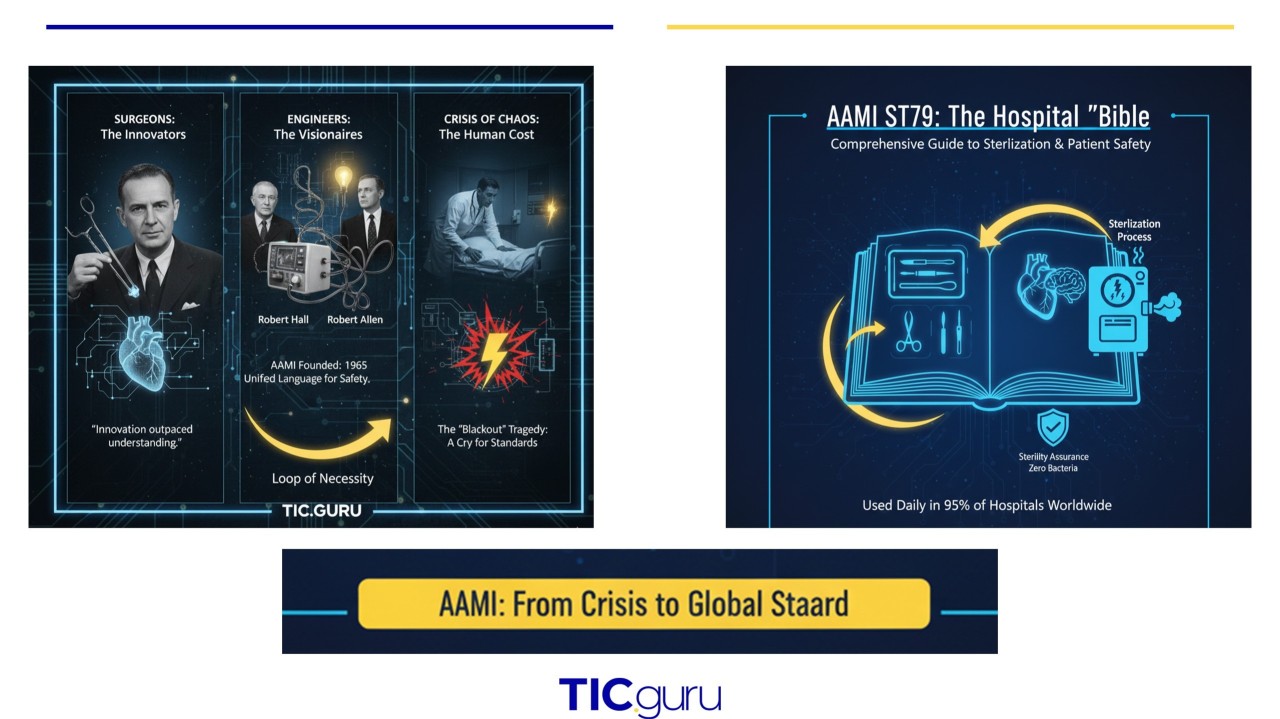
The Historic Origins: Surgeons, Engineers, and a Crisis of Chaos
The story of AAMI begins in the mid-1960s, a period of "cowboy" innovation in medicine. Surgeons like Dwight Harken—the first to successfully remove shrapnel from a human heart—and Michael DeBakey were inventing life-saving devices faster than the world could understand them.
Founded in 1965 by entrepreneurs Robert Hall and Robert Allen, AAMI was established to solve a deadly problem: the lack of a common technical language between the doctors using the tools and the engineers building them. It wasn't just about standards; it was about building a "bridge of trust" to ensure that a power outage or a faulty wire wouldn't end a life.
The Pillars : Key AAMI Standards
Today, AAMI manages over 350 standards, but three specific series define the modern industry:
- AAMI ST79 (The Sterilization Bible): In 2026, this remains the definitive guide for steam sterilization in every hospital's Central Sterile Processing Department (SPD). It is the thin line between a successful surgery and a life-threatening infection.
- ANSI/AAMI/ISO 14971 (Risk Management): The "Universal Mind" of medical design. It forces every MedTech firm—from Medtronic to Stryker —to prove they have mitigated every possible risk before a device ever touches a patient.
- AAMI TIR57 & SW96 (The Cybersecurity Shield): As devices become smarter, they become targets. These standards are the industry’s defense against the $10M+ ransomware attacks that now threaten hospital networks.
The Interconnected Network of Trust
AAMI doesn't work in isolation. It uses the ISO/CASCO Toolbox as its global delivery system, turning technical standards into market-ready compliance programs:
The 2026 Global Shift: On January 1, 2026, the IAF and ILAC officially merged into the Global Accreditation Cooperation (GAC). This has simplified the AAMI network significantly: one audit now grants you access to almost every major market on earth.
Extent and Reach: Markets, Countries, and Economies
The "AAMI Way" is no longer just an American preference; it is a global mandate.
- Top Markets: The USA (California and Minnesota clusters), Ireland (the EU MedTech gateway), and India (the fastest-growing market for AAMI-compliant digital health).
- FDA Harmonization: As of this month, the FDA's QMSR means that AAMI/ISO standards are now the mandatory legal baseline for the U.S. market, affecting every firm from GE HealthCare to Philips .
- The Business Growth Engine: Compliance is the new competitive advantage. Firms like Greenlight Guru and Qualio have built billion-dollar platforms specifically to help startups achieve "AAMI-Ready" status, increasing their M&A valuation by up to 20%.
Beyond Compliance
AAMI is the silent partner in every operating room. By bridging the gap between historical medical necessity and future AI-driven cybersecurity, AAMI ensures that the technology of tomorrow remains safe, reliable, and accessible today.
#AAMI #MedTech #PatientSafety #FDA2026 #ISO13485 #Cybersecurity #HealthcareInnovation #Sterilization #MedicalDevices #CASCO #GlobalAccreditation
AAMI FDA ISO - International Organization for Standardization Medtronic Stryker Johnson & Johnson MedTech GE HealthCare Philips Siemens Healthineers BSI TÜV SÜD SGS Intertek Nelson Labs Greenlight Guru Qualio ANAB - ANSI National Accreditation Board