
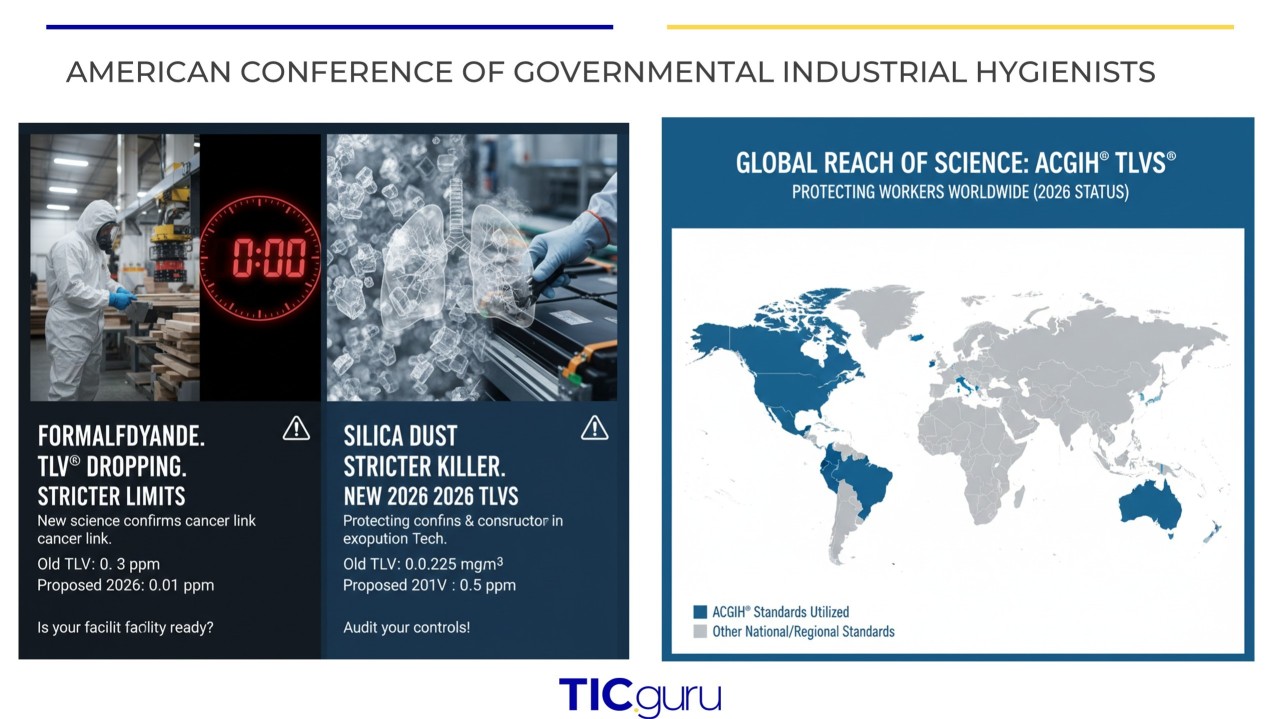
Now, occupational health has moved beyond the "hard hat and boots" era. We are now in the age of The Molecular Workplace, where the difference between a healthy career and a chronic illness is measured in parts per billion.
At the center of this movement is the ACGIH - American Conference of Governmental Industrial Hygienists (ACGIH®). If you are in EHS, compliance, or manufacturing, this is the organization setting the scientific tempo for your operations. Here is your comprehensive 2026 briefing on why ACGIH is the global compass for workplace safety.
From the "New Deal" to Global Science
Founded in 1938 (originally as the National Conference of Governmental Industrial Hygienists), the ACGIH is a member-based scientific association. It is not a regulatory agency; instead, it provides the technical evidence that regulators worldwide use to build their laws.
- The 1938 Genesis: Born in the wake of FDR’s New Deal, it was formed to coordinate the efforts of state and local government industrial hygienists during the rapid industrial expansion of the pre-war era.
- The 1946 Adoptation: A monumental year. ACGIH adopted its first list of 148 exposure limits, then called "Maximum Allowable Concentrations."
- The 1956 Rebrand: The term Threshold Limit Value (TLV®) was officially introduced, a term now synonymous with chemical safety globally.
- The 1970 OSHA Act: When OSHA was created in the US, it adopted the 1968 ACGIH TLVs as the baseline for the first federal Permissible Exposure Limits (PELs).
The Technical Blueprint: TLVs and BEIs
The ACGIH’s primary "products" are not machines, but scientific values that determine the safety of the air we breathe and the environments we touch.
- Threshold Limit Values (TLVs®): Guidelines that represent levels of exposure a worker can experience daily without adverse health effects. They cover:
- Biological Exposure Indices (BEIs®): Standards for "internal" safety—measuring the concentration of chemicals in biological samples like blood or urine.
- Industrial Ventilation Manual: Known as the "Ventilation Bible," this is the definitive engineering guide for designing airflow systems to remove toxic contaminants from factories.
The "Why" Behind the Values
For every single TLV or BEI, ACGIH publishes a Documentation file. These are not just "numbers"; they are peer-reviewed technical papers (often 10–50 pages long) that summarize the entire history of human and animal testing for that substance.
- The Documentation of the TLVs and BEIs (9th Edition / Digital Library): An expansive database containing the scientific justification for over 700 chemical substances and physical agents.
The Conformity Assessment Engine
The ACGIH® guidelines are not "conformity assessment standards" in the legal sense—meaning the ACGIH doesn't run a certification scheme themselves—but their publications are the technical baseline used by almost every accredited body in the world to determine if a workplace "passes" an audit.
Here is how specific ACGIH publications are used within the ISO/CASCO framework.
In 2026, the CASCO (Committee on Conformity Assessment) framework is undergoing a significant expansion to keep pace with the rapid scientific updates from ACGIH®. As ACGIH moves beyond traditional chemistry into complex areas like Whole Body Vibration, Workplace Fatigue, and AI-monitored exposures, a "New Era of Conformity" has emerged.
The following table identifies the 2026 Opportunities for conformity assessment programs, bridging the gap between ACGIH’s latest scientific adoptions and the ISO/CASCO structural toolbox.
Strategic Shift: What’s New?
There is a massive pivot in how ACGIH influences the market this year:
- The "Notice of Intended Changes" (NIC): Limits for substances like Formaldehyde and Silica are dropping to record lows. If your ventilation isn't ready, your compliance will fail by 2027.
- Whole Body Vibration: New focus on long-haul drivers and heavy machinery operators to prevent chronic spinal injury.
- Fatigue Management: For the first time, ACGIH is providing clear benchmarks for shift-work recovery, turning "burnout" from a HR issue into a measurable safety hazard.
- EV Battery Safety: Dedicated research into the specific toxicological profiles of lithium-ion recycling and electrolyte exposure.
The Science Orchestrators: ACGIH Leadership
These individuals are the "Guardians of the TLVs." They manage the committees that evaluate new data and decide when a threshold needs to drop.
The Board of Directors
- Phillip Rauscher MPH, CAE, ACNP, CIH, CSP , MPH, CIH, CSP: Executive Director
- Stephanie Lynch, PhD, CIH, CSP OHD , PhD, CSP, COHC: ACGIH Board Chair.
- Torey Nalbone , PhD, CIH, FAIHA: Treasurer and University of Texas at Tyler expert.
- Michael Grant, ScD, CIH : Board Member and key liaison for Industrial Ventilation.
- Beth Angus, CIH , : Representing industry giants (Franklin International)
The Implementation Giants: Organizational Supporters
These businesses don't just "follow" ACGIH; they are active Organizational Supporters who integrate these standards into their global corporate DNA to mitigate long-term risk.
Global Industry Leaders
- 3M : A massive player in respiratory protection and lab equipment.
- Honeywell Technologies : A leader in gas detection and PPE technology.
- ExxonMobil & Shell : Critical users for petrochemical and refinery safety standards.
- Colgate-Palmolive & Johnson & Johnson : Major players in chemical safety for consumer goods.
- Rivian : Representing the new wave of EV Battery safety challenges.
- Northrop Grumman : Implementing high-level hygiene for aerospace and defense.
Consulting & Technical Firms
- Bureau Veritas , SGS , Intertek The world’s leading testing and inspection firms.
- Terracon : High-level environmental and engineering consultants.
The Conformity & Regulatory Partners
These are the bodies that turn ACGIH's "Science" into "Enforcement" or "Accreditation."
- National Institute of Occupational Safety and Health (NIOSH) : The US federal research partner that often co-funds the science ACGIH relies on.
- OSHA : While they set the legal limits, they are the primary user of ACGIH's data for new Rulemaking.
- American Industrial Hygiene Association (AIHA) (American Industrial Hygiene Association): The sister organization focused on the "Practice" of IH while ACGIH focuses on the "Science."
#ACGIH #IndustrialHygiene #WorkplaceSafety #EHS #OccupationalHealth #ISO45001 #ISO17025 #TLVs #BEIs #ChemicalSafety #VentilationEngineering #SafetyLeadership #PublicHealth #SafetyFirst #IndustrialSafety #CleanAir #WorkerProtection #Ergonomics #RiskManagement #EnvironmentalHealth #Sustainability #SafetyTech #2026Trends #ManufacturingSafety #GlobalStandards #CIH #SafetyAudit #Compliance #HealthyWorkplace #SafetyCulture