
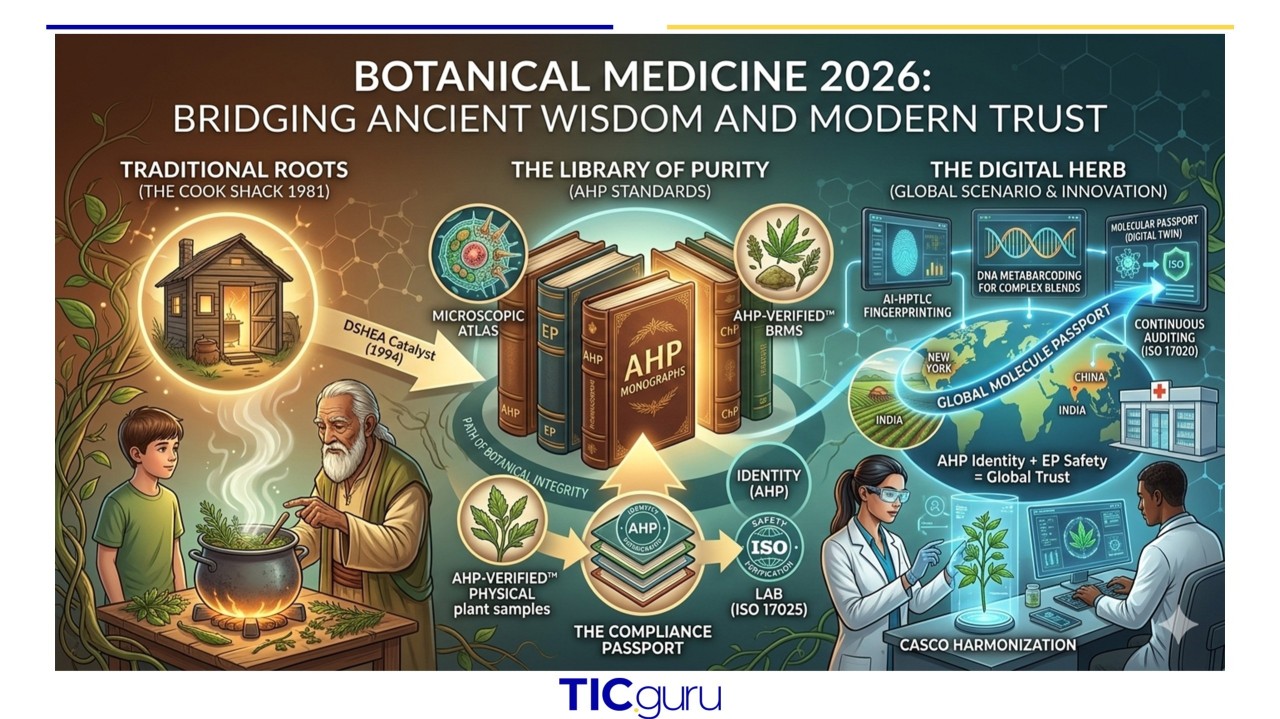
In an era where "Clean Label" and "Food as Medicine" have moved from the fringe to the global mainstream, the integrity of the botanical supply chain is the new frontier of consumer trust. At the heart of this movement is the American Herbal Pharmacopoeia (AHP). This article explores the link of the Compliance Industry based on what started as nomadic quest for plant wisdom evolved into the "Technical Constitution" for a $13B+ industry.
The AHP story didn't start in a sterile boardroom; it began in 1981 in a rustic cook shack in Nevada. Founder Roy Upton realized that while the modern world had "deleted" herbs from official medical texts, traditional healers maintained a rigorous precision about plant quality.
Founded formally in 1995, the AHP became a rescue mission—marrying 19th-century botanical expertise with 21st-century analytical chemistry. When the DSHEA Act of 1994 opened the door for the herbal industry, the AHP provided the scientific floorboards to ensure that growth was built on safety and truth.
Shall we continue with our tradition? Here we go then
The "Library of Purity": Standards That Matter
The American Herbal Pharmacopoeia (AHP) produces a highly specialized body of work designed to bridge the gap between historical botanical knowledge and modern regulatory requirements. In 2026, their publications are categorized into three major streams: Monographs, Textbooks, and Physical Standards.
Inside an AHP Monograph: The Trust Layers
Each monograph is not just a document; it is a multi-layered verification tool used by quality control (QC) labs to ensure a plant is exactly what it claims to be.
- Layer 1: Botanical Identification The physical "DNA" of the plant, including detailed illustrations of leaves, seeds, and stems.
- Layer 2: Microscopic Fingerprinting Detailed imaging of the plant's cell structure (secretory glands, trichomes, and starch grains). This is the only way to spot a "chemical spike" where a manufacturer has added synthetic active ingredients to a fake plant.
- Layer 3: Chemical Fingerprinting (HPTLC) High-Performance Thin-Layer Chromatography profiles. This creates a unique "visual barcode" of the plant's chemical compounds.
The Global Scenario: The "Molecule Passport"
The global botanical market is a patchwork of regional powers. While the USP (USA) and European Pharmacopoeia (EP) set the legal safety limits, the AHP is the global leader in Identity Verification.
We are seeing the rise of the "Bilateral Recognition" model. An herb grown in India or China can now carry a "Digital Molecule Passport"—verified against AHP standards for identity and EP standards for safety—allowing it to pass through international borders with a single, blockchain-backed certificate of integrity.
Lets look at this high-stakes ecosystem of Bilateral Recognition. While the AHP is the "Technical Soul" of the North American market, other regions follow their own legally enforceable compendia.
The Global "Big Four" Herbal Standards
Compliance in the Age of AI and Genomics
Under the ISO/IEC 17000 (CASCO) framework, AHP provides the Scheme Rules (the Monographs) that Conformity Assessment Bodies (CABs) use to verify that a botanical product is safe, authentic, and legally compliant.
Botanical Compliance Programs Mapping
Let tabulate how some these stakeholder are driving the current Assurance Industry Frameworks. American Herbal Pharmacopoeia Alkemist Labs SGS FDA Inspectors, Quality Control Managers, NSF UL Solutions ANAB - ANSI National Accreditation Board A2LA International Accreditation Service, Inc. (IAS) USDA Regenerative Organic Alliance CCOF
Future Innovative Compliance Matrix: Botanical Medicine (2026–2035)
Gemini said
In 2026, the intersection of Artificial Intelligence, Blockchain, and Genomics is creating a new frontier for botanical compliance. While the current AHP standards focus on physical and chemical identity, these "Future Schemes" move toward Continuous, Real-time, and Immutable Validation.
Here are six innovative compliance programs designed for the next decade of botanical medicine, mapped to their respective ISO/IEC (CASCO) frameworks.
The Botanical Power List
To stay ahead of the 2026 botanical curve, follow the people and organizations defining the "Trust Layer" of our industry.
The Guardians of the Standard:
- American Herbal Pharmacopoeia (AHP)
- Roy Upton (President & Founder, AHP)
- @John Cardellina (AHP Board Chair & Natural Products Expert)
The Scientists & Laboratories (The Referees):
- Alkemist Labs ( Elan Sudberg – Leading the charge in transparency and identity testing)
- National Center for Natural Products Research ( NCNPR)
- SGS & Eurofins (Global TIC leaders implementing AHP-level rigor)
- HPTLC Association (Advancing the visual "barcode" of plant chemistry)
The Industry Adopters & Advocates:
- American Herbal Products Association (AHPA) (American Herbal Products Association)
- American Botanical Council ( Mark Blumenthal )
- Gaia Herbs (Pioneers in consumer-facing transparency)
- Traditional Medicinals (The benchmark for pharmacopoeial grade teas)
- Herb Pharm & Herbalist & Alchemist, Inc. (The original "Herbal Renaissance" makers)
- Nuherbs ( Wilson Lau – Bridging TCM and modern quality standards)
The Regulatory & Educational Specifiers:
- U.S. Food and Drug Administration - Office of Criminal Investigations (OCI) (FDA)
- Health Canada | Santé Canada (NNPBD)
- American College of Healthcare Sciences (ACHS) (Training the next generation of compliance herbalists)
#AHP2026 #HerbalIntegrity #BotanicalStandards #QualityControl #ISO17025 #CleanLabel #DigitalProductPassport #BotanicalMedicine #ComplianceInnovation