
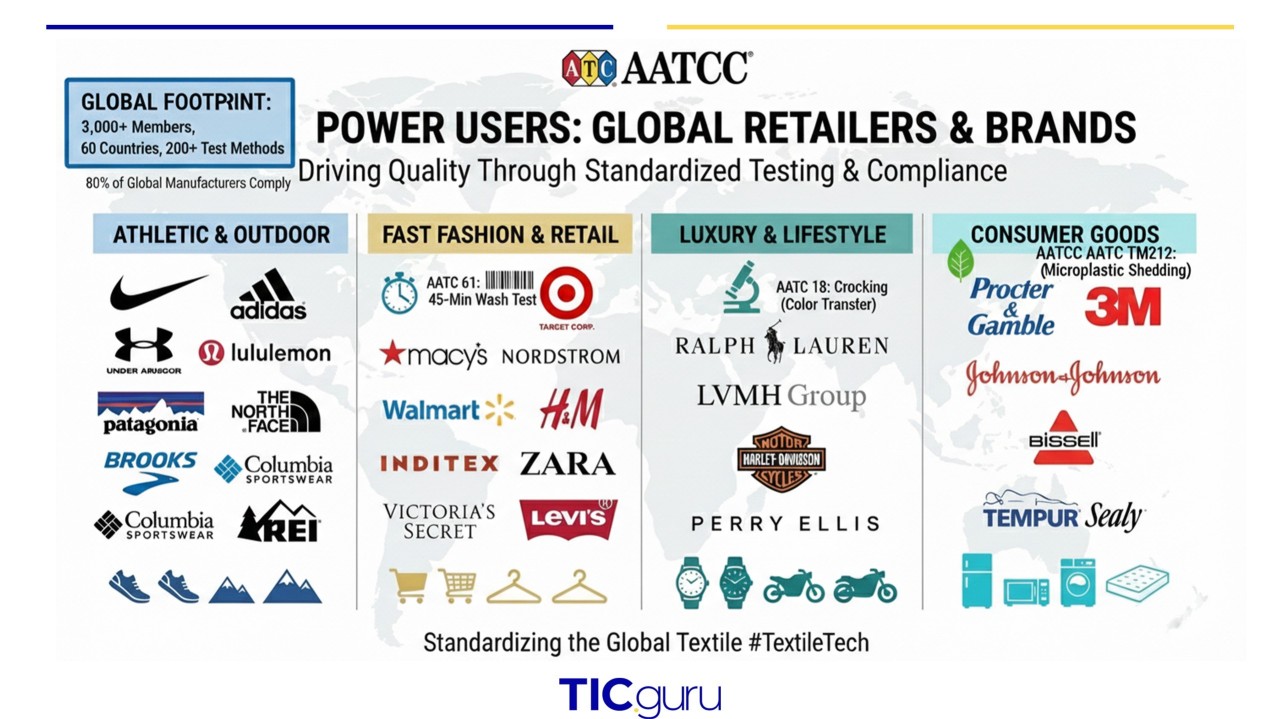
In the intricate tapestry of the global textile industry, where innovation meets tradition and art converges with engineering, a set of standards quietly underpins quality, consistency, and trust. While national borders often define economies, the American Association of Textile Chemists and Colorists ( AATCC ) standards have transcended geographical lines, creating a powerful, interconnected network that empowers businesses more than individual countries.
This article delves into the origins, key principles, and expansive reach of AATCC standards, exploring their vital role in the global textile supply chain and their alignment with the principles of CASCO (ISO Committee on Conformity Assessment) – ultimately revealing how they foster an industry-driven ecosystem of excellence.
From American Mills to Global Markets: The Genesis of AATCC
Born in the USA in 1921, the AATCC emerged from a need to standardize testing methods in a rapidly industrializing textile sector. Initially focused on domestic challenges like dye application and fabric finishing, its mission was clear: to promote research, disseminate knowledge, and establish test methods to improve the quality of textile materials.
Over a century later, AATCC has evolved from a regional entity to a globally recognized authority. Its headquarters in Research Triangle Park, North Carolina, USA, remains a hub of innovation, but its influence stretches far beyond, touching every continent where textiles are produced, tested, and consumed.
The Pillars of Quality: Key AATCC Standards
AATCC publishes hundreds of test methods, evaluation procedures, and monographs, covering a vast array of textile properties. Some of the most widely recognized and critical standards include:
The CASCO Connection: Building a Global Conformity Network
The true power of AATCC standards lies in their integration within a global conformity assessment infrastructure, mirroring the principles laid out by CASCO (the ISO Committee on Conformity Assessment). CASCO develops international standards and guides for conformity assessment practices, such as accreditation, certification, and testing. AATCC standards, while originating independently, slot seamlessly into this framework
By using the CASCO framework as the pivot, AATCC standards have effectively bypassed the need for 195 different national laws. Instead, they rely on a mutual recognition system. When Levi Strauss & Co. requests a test using AATCC TM 61, they aren't just following an American rule; they are leveraging a global infrastructure of accredited experts.
This network has empowered the textile industry to become more agile than the countries it operates in—allowing goods to move across borders with the confidence that quality is constant, regardless of the flag flying over the factory.
Industry Empowerment: Beyond National Mandates
The genius of AATCC standards, within this CASCO-aligned framework, is their ability to empower the industry itself. Unlike government-mandated national standards, AATCC standards are primarily industry-driven. They are developed by consensus among textile scientists, manufacturers, brands, and academia – creating a system that directly addresses the practical needs and challenges of the textile value chain.
The Unseen Global Workforce
The reach of AATCC extends to the countless textile professionals globally – chemists, engineers, quality managers, and lab technicians – who are trained in, perform, and interpret these standards daily. Organizations like the Textile Institute and various university textile programs often incorporate AATCC methodologies into their curriculum, creating a continuously skilled workforce that transcends national boundaries.
The Regional Tapestry: A Map of Divergent Disciplines
While AATCC acts as a central nervous system for North American quality, the global textile landscape is a mosaic of regional loyalties. Understanding this geography is essential for any business navigating international trade:
- The European Fortress (ISO & EN): Across the European Union, the ISO and EN (European Norm) standards are the law of the land. In markets like France, Italy, and Germany, standards are often integrated into strict environmental and chemical regulations (like REACH). Businesses such as LVMH, Kering, and Inditex (Zara) often pivot between ISO for their European retail compliance and AATCC for their significant North American exports.
- The Asian Powerhouses (GB & JIS): China employs its mandatory GB (Guojia Biao Zhun) standards, which are unique because they carry legal weight for internal domestic sales. Meanwhile, Japan relies on JIS (Japanese Industrial Standards), governed by the JISC. Companies like Fast Retailing (Uniqlo) must master a "triple-standard" approach: GB for China, JIS for Japan, and AATCC/ISO for the rest of the world.
- The Oceania Connection (AS/NZS): In Australia and New Zealand, the AS/NZS standards dominate, particularly concerning sun protection (UPF) and wool quality. Brands like Quiksilver or Billabong have historically led the charge in these specialized testing niches, ensuring that performance wear stands up to the unique environmental rigors of the Southern Hemisphere.
#AATCC #TextileStandards #QualityControl #GlobalTextiles #SupplyChain #ConformityAssessment #Accreditation #TextileInnovation #Manufacturing #TextileIndustry #Sustainability #TextileTesting
Born in the USA in 1921, the AATCC emerged from a need to standardize testing methods in a rapidly industrializing textile sector. Initially focused on domestic challenges like dye application and fabric finishing, its mission was clear: to promote research, disseminate knowledge, and establish test methods to improve the quality of textile materials.
Over a century later, AATCC has evolved from a regional entity to a globally recognized authority. Its headquarters in Research Triangle Park, North Carolina, USA, remains a hub of innovation, but its influence stretches far beyond, touching every continent where textiles are produced, tested, and consumed.
#AATCC #TextileStandards #QualityControl #GlobalTextiles #SupplyChain #ConformityAssessment #Accreditation #TextileInnovation #Manufacturing #TextileIndustry #Sustainability #TextileTesting
AATCC & Standard Leadership (The Architects)
- AATCC (American Association of Textile Chemists and Colorists)
- Christina Rapa – Current President of AATCC (also at W.L. Gore & Associates)
- Sabyasachi Gaan – Chair of Chemical Applications Interest Group (Empa)
- Chris Hipps – Chair of Concept 2 Consumer (Archroma)
- Dr. Apurba Banerjee – Chair of Materials Interest Group (Standard Textile)
- Yongxin Wang – Vice-Chair of Materials Interest Group (W.L. Gore & Associates)
- Diana Wyman – Executive Vice President of AATCC
Major Brands & Retailers (The Drivers)
These companies are the primary "customers" in the CASCO pivot who demand AATCC compliance for market entry.
- Nike – ( Andrew Campion )
- adidas –
- Levi Strauss & Co. – Jeffrey Hogue
- VF Corporation (The powerhouse behind North Face, Vans, Timberland)
- Gap Inc. – Richard Dickson
- Target
- Walmart
- LVMH
- H&M Group Helena Helmersson
- Under Armour Kevin Plank
Conformity Assessment & Accreditation (The Pivot)
These are the bodies that bridge the gap between the standard and the physical product.
- SGS Géraldine Picaud
- Intertek – André Lacroix
- Bureau Veritas Hinda Gharbi
- UL Solutions
- TÜV SÜD / TÜV Rheinland Group
- ANAB - ANSI National Accreditation Board (ANSI National Accreditation Board) Keith Mowry
- A2LA (American Association for Laboratory Accreditation)
- ISO - International Organization for Standardization
Innovation & Material Partners
Companies that use AATCC standards to prove their technical superiority.
- W. L. Gore & Associates
- DuPont
- Archroma
- Lenzing Group
- Huntsman Corporation